Blended Versus In Person First Aid: Which Works?
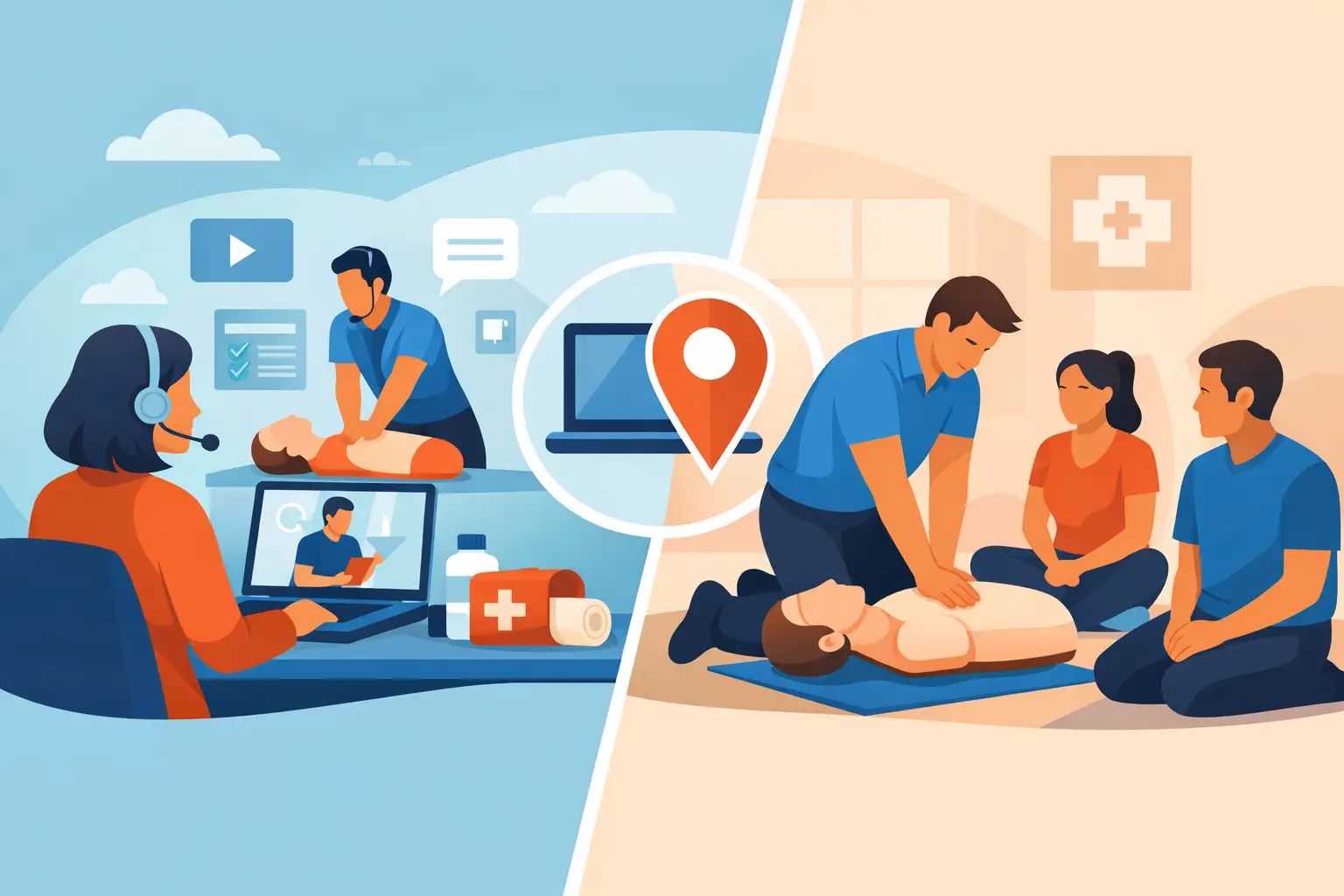
A missed training day can delay a new hire, leave a shift short-staffed, or put a workplace certification requirement at risk. The decision between blended versus in person first aid is not simply about convenience. It affects how learners complete coursework, practice emergency skills, and receive a credential that meets employer and workplace expectations.
For many Ontario employees, supervisors, security professionals, and job seekers, a blended course offers the most practical route: complete knowledge-based material online, then attend an instructor-led session for hands-on assessment. A fully in-person class remains a strong choice when a group needs direct classroom instruction from start to finish. The right option depends on the certification required, the learner’s schedule, and the need for practical skill development.
Blended versus in-person first aid: the practical difference
In-person first aid training places all course content in a classroom. Learners review emergency procedures with an instructor, participate in demonstrations, complete knowledge checks, and practice physical skills during scheduled class time. This format suits people who prefer live instruction throughout the entire course or who need training arranged for a team at one location.
Blended first aid training separates the course into two parts. The online portion covers theory, including how to recognize emergencies, activate emergency response systems, prevent infection, document incidents, and understand first aid priorities. The in-person portion focuses on the skills that cannot be properly learned by reading or watching alone.
At Canada First Aid, Intermediate First Aid Level C with AED certification is structured as 8 hours of online coursework and 8 hours of in-person training. This format gives learners flexibility for the theory portion while preserving the instructor-led, hands-on component needed for practical emergency response training.
The key point is straightforward: blended learning is not an online-only course. A legitimate blended first aid course still requires learners to attend an in-person session, demonstrate required skills, and meet the instructor’s assessment standards.
What learners do online
The online component is designed for material that benefits from self-paced review. Learners can work through course modules before attending class, rather than spending a full day covering content that can be studied independently.
Online coursework commonly addresses how to assess a scene for danger, obtain consent, use personal protective equipment, recognize shock, respond to medical emergencies, and understand legal and reporting responsibilities. Depending on the program, it may also cover head and spine injuries, environmental emergencies, poisoning, and sudden medical conditions.
This flexibility is valuable for people balancing shift work, job searches, school, or family commitments. Instead of requiring every hour of learning to occur on one or two fixed dates, learners can complete the online section within the provider’s required timeline before the classroom date.
That flexibility still requires discipline. The online modules must be completed in full, and learners should not leave them until the night before the practical session. Arriving prepared allows the instructor-led portion to focus on performance, questions, and real-world application.
Why the in-person session still matters
First aid certification is based on more than knowing the correct answer to a multiple-choice question. A responder must be able to assess the situation, communicate clearly, position a casualty safely, perform CPR with appropriate technique, use an AED trainer, and respond under pressure.
These are physical and judgment-based skills. An instructor can correct hand placement during CPR, confirm effective compressions, observe safe recovery-position technique, and ensure a learner can follow the required steps in sequence. Classmates also create realistic practice opportunities that online modules cannot duplicate.
For Level C training, the hands-on portion is especially significant because CPR and AED response may involve adults, children, and infants. Learners need supervised practice with mannequins and training equipment before they can be assessed as competent.
A course that claims to offer complete workplace first aid certification with no in-person skill evaluation should be reviewed carefully. Employers and workers should confirm that the format, provider, and certificate meet the specific standard required for the job or workplace.
Recognition and workplace requirements come first
The best format is the one that meets the requirement attached to the role. Before registering, learners should verify what their employer, hiring manager, licensing body, or workplace safety program requires. Some positions specify a particular level of first aid, CPR level, AED training, or provider recognition.
For Ontario workplaces, certification requirements may be tied to workplace first aid obligations and WSIB-recognized training standards. Employers should confirm the level required for their workforce and ensure employees receive a certificate accepted for the intended purpose.
Do not assume that any first aid certificate is interchangeable. A short awareness course, an online-only course, and an Intermediate First Aid Level C with AED certificate serve different purposes. The course title, delivery format, practical assessment, certification validity period, and provider authorization all matter.
This check is particularly important for security staff, supervisors, construction personnel, childcare-related roles, and employees assigned to workplace emergency response duties. If a job posting or employer states a specific certification requirement, register for that exact level rather than choosing a course based only on the shortest available schedule.
When blended training is the better choice
Blended training works well when learners need a recognized, practical credential but cannot easily attend a longer classroom program. It reduces the time spent away from work or other responsibilities while keeping required skills practice in person.
It is often a good fit for individual registrants who can complete online study independently. Job seekers may use the flexible online portion to prepare before an upcoming course date. Employers may also find the format useful when scheduling employees across rotating shifts, since less time must be coordinated in a classroom.
Blended delivery is most effective when the learner has reliable internet access, can complete the online component without repeated interruptions, and is comfortable reading course material on a computer or mobile device. The practical class should still be treated as a mandatory assessment day, not as a brief formality.
When fully in-person training makes more sense
A traditional classroom course may be the better choice for learners who benefit from direct instructor guidance throughout the full program. Some participants retain information better when they can ask questions immediately, discuss scenarios as a group, and receive explanations in real time.
It can also be the simpler option for an employer training a group together. A single scheduled classroom session gives the instructor control over course pacing and allows the entire team to learn the same procedures at the same time. This can be useful when workers have limited computer access or when management wants to minimize the risk of incomplete online modules.
Fully in-person delivery may also suit learners who are new to first aid and feel uncertain about self-directed coursework. There is no disadvantage in choosing a classroom course if the schedule works. The goal is competent, recognized training, not choosing a format for its own sake.
How to choose without wasting time or money
Start with the required certification level. Confirm whether the role requires Emergency First Aid, Intermediate First Aid, CPR Level C, AED training, or a combination. Then confirm the acceptance standard with the employer or organization requesting the certificate.
Next, look at the real time commitment. A blended course may reduce classroom hours, but it does not eliminate course hours. Plan for both the online module and the in-person skills session. Missing the practical session or arriving without completing the online prerequisite can delay certification.
Also consider how you learn. A self-directed learner with an unpredictable schedule may prefer blended training. Someone who wants continuous instructor support may get more value from a fully classroom-based course. For employers, consider whether staff can reliably complete online modules before the scheduled practical date.
Finally, review practical details before registration: course location, scheduled dates, identification requirements, what to bring, cancellation policies, certification issuance, and any prerequisites. Clear information at the start prevents avoidable problems on training day.
The certification should build real readiness
Compliance is a valid reason to take first aid training, but it should not be the only outcome. The strongest courses leave learners able to take immediate, organized action while waiting for emergency medical services. That means staying safe at the scene, calling for help, using available equipment, and providing care within the limits of training.
Blended and fully in-person formats can both support that outcome when they include proper instruction, hands-on practice, and assessment. The difference is how the knowledge portion is delivered, not whether practical competence matters.
Choose the course format that fits your required credential and your ability to complete every part properly. When an emergency occurs, the value of the certificate is in the calm, correct action you are prepared to take.