Best CPR Training for Security Staff in Ontario
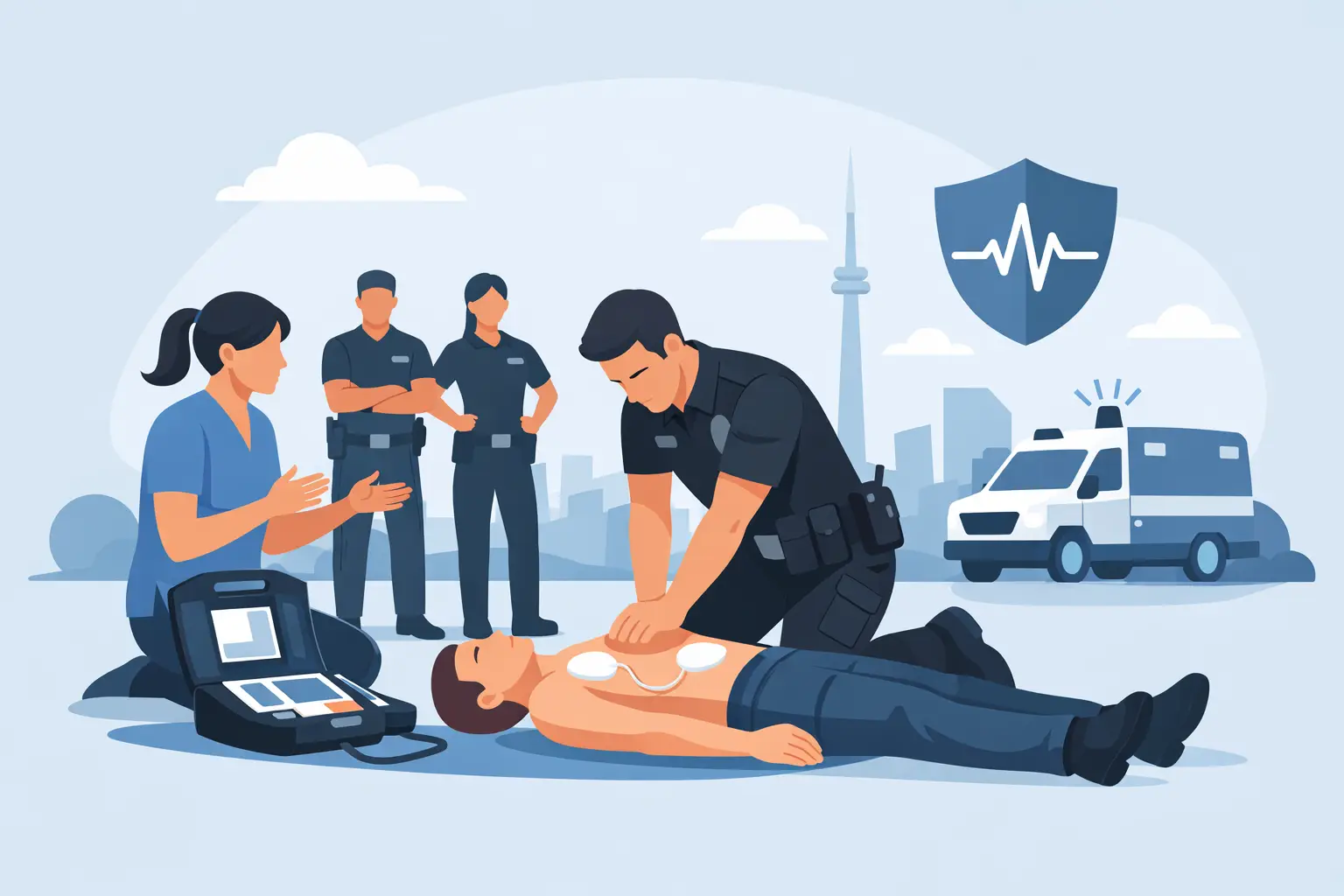
A security officer may be first on scene when a visitor collapses, a worker is injured, or a crowd incident creates a medical emergency. The best CPR training for security staff is not simply the shortest available class. It should provide a recognized credential, practical CPR and AED instruction, and a course format that fits the operational demands of security work.
For Ontario security personnel, Intermediate First Aid Level C with AED certification is often the appropriate standard when an employer requires comprehensive first aid and CPR training. It prepares learners to respond before paramedics arrive while giving employers a clear, recognized training record for workplace safety purposes.
What Security Staff Need From CPR Training
Security work is unpredictable. Officers may work alone, patrol large properties, manage public access, support events, monitor cameras, or respond to alarms. In many of these environments, the first person available to assess an emergency may be a security professional.
A suitable course should teach more than chest compressions. Security staff need to recognize an unresponsive person, assess scene safety, call for emergency assistance, use an automated external defibrillator (AED), and provide effective CPR until the response is transferred to paramedics. They also need first aid skills for bleeding, choking, seizures, shock, diabetic emergencies, and other incidents that may occur on a shift.
The course should be practical. Security personnel must be able to act under pressure, communicate clearly with dispatch or emergency services, and control access around an incident without delaying care. Classroom knowledge matters, but hands-on practice is where learners build the confidence to apply it.
Why Level C CPR With AED Is a Strong Choice
CPR certifications are not all equivalent. A basic CPR-only class may meet a limited personal requirement, but it may not cover the range of first aid situations encountered in security roles. Before registering, confirm the exact certification level named in the job posting, site contract, company policy, or client requirement.
Level C CPR generally covers adult, child, and infant CPR, along with choking response and AED use. That broader scope is relevant for security staff working in residential buildings, retail centers, schools, public facilities, events, or locations where people of different ages may be present.
AED training is equally important. Early defibrillation can be critical during sudden cardiac arrest. Security officers are often assigned to large facilities where an AED is on site but may not be immediately accessible to every employee. Training should include realistic AED practice so the learner understands how to retrieve, prepare, and operate the device while continuing coordinated care.
Intermediate First Aid adds another layer of readiness. It addresses medical and trauma emergencies beyond CPR, which is useful when an officer is waiting with an injured person, assisting a supervisor, or managing the first minutes of a serious incident.
How to Choose the Best CPR Training for Security Staff
The right course depends on the duties of the role and the employer's stated standard. However, several selection factors should be non-negotiable.
Confirm Recognition Before You Enroll
A certificate only helps if the employer accepts it. Ontario job seekers and employers should look for training that is WSIB-recognized when workplace compliance is part of the requirement. Ask whether the certificate includes the required first aid, CPR Level C, and AED components, and verify the certificate's validity period with the employer.
Do not assume that a short online-only course will meet a workplace requirement. Many employers require instructor-led practical evaluation because CPR, AED use, bandaging, and emergency scenarios require demonstrated skills. If a posting specifies recognized first aid certification, confirm the delivery method and credential before paying for training.
Look for Meaningful Hands-On Instruction
Effective CPR requires correct technique, appropriate compression depth and rate, and the ability to continue care without unnecessary delays. These are physical skills. In-person instruction gives learners time to practice with training manikins, use an AED trainer, perform recovery-position procedures, and receive correction from an instructor.
For security staff, scenario-based practice adds value. A response at a condo lobby differs from a response in a warehouse, a nightclub, or a construction entrance. The medical priorities remain the same, but scene safety, crowd control, radio communication, and access for paramedics can change the response. Good training helps learners separate those operational tasks from the immediate need to provide care.
Consider a Blended Format When Scheduling Is Tight
Shift work can make a traditional two-day classroom course difficult to attend. Blended learning can be a practical option when it includes both required online coursework and in-person skills training. Learners can complete theory on their own schedule, then attend a scheduled practical session for instruction and evaluation.
Canada First Aid offers Intermediate First Aid Level C with AED certification through an 8-hour online component and 8 hours of in-person training. This format suits security personnel who need a recognized credential without losing more time than necessary from rotating shifts or work commitments.
The trade-off is straightforward: online learning requires self-discipline. Learners should complete the modules carefully rather than rushing through them for the certificate. The in-person session is most useful when participants arrive prepared to focus on practical application.
Check Course Timing and Certificate Requirements
Registration should be simple, but the details matter. Confirm the course date, training location, total time commitment, what identification is required, and whether the certificate is issued after successful completion. If the certification is needed for a job start date or contract renewal, leave time for training and processing rather than waiting until the deadline.
Employers should also plan ahead. Scheduling several guards individually at the last minute can create coverage problems. A training plan tied to hiring cycles, certificate expiry dates, and site requirements is easier to manage and helps avoid preventable compliance gaps.
CPR Training Should Fit the Security Role
Not every security assignment carries the same medical risk. A guard at a quiet access-control desk may have fewer direct emergency encounters than an event security team or a mobile patrol officer. Still, emergency preparedness is part of professional readiness because serious incidents are rarely scheduled.
For positions involving public contact, remote work areas, overnight shifts, vulnerable populations, or large premises, a broader first aid and Level C CPR credential is often the more sensible choice. The extra training supports a response to medical emergencies that may not involve cardiac arrest, such as severe bleeding, an allergic reaction, or a person who is unconscious but breathing.
Security officers should also understand the limits of their role. First aid training prepares a person to provide immediate care within their training while emergency services are activated. It does not replace professional medical treatment, site emergency procedures, or the need to protect the scene when hazards are present. A trained responder must assess whether it is safe to approach before beginning care.
Questions to Ask Before Booking
Before choosing a provider, ask whether the course is accepted by your employer, includes CPR Level C and AED certification, has an in-person practical component, and meets WSIB recognition requirements when applicable. Also ask about course duration, certificate issuance, renewal expectations, and available dates.
These questions are especially useful for job seekers. A security employer may use general language such as “first aid required,” while the actual contract requires a specific level of CPR certification. Getting confirmation early prevents the cost and delay of taking the wrong course.
For supervisors and business owners, consistency matters. Setting one clear certification standard for guards assigned to a site makes records easier to manage and gives staff a common response framework during an emergency.
Build Readiness Before an Emergency Happens
The best course is one that leaves security staff ready to act, not merely holding a certificate. Choose recognized Level C CPR with AED and first aid training when the role calls for it, complete the practical work seriously, and keep certification current. When a medical emergency occurs, those decisions can give a responder the structure and confidence to take the right first steps.