Is Blended First Aid Valid for Jobs in Ontario?
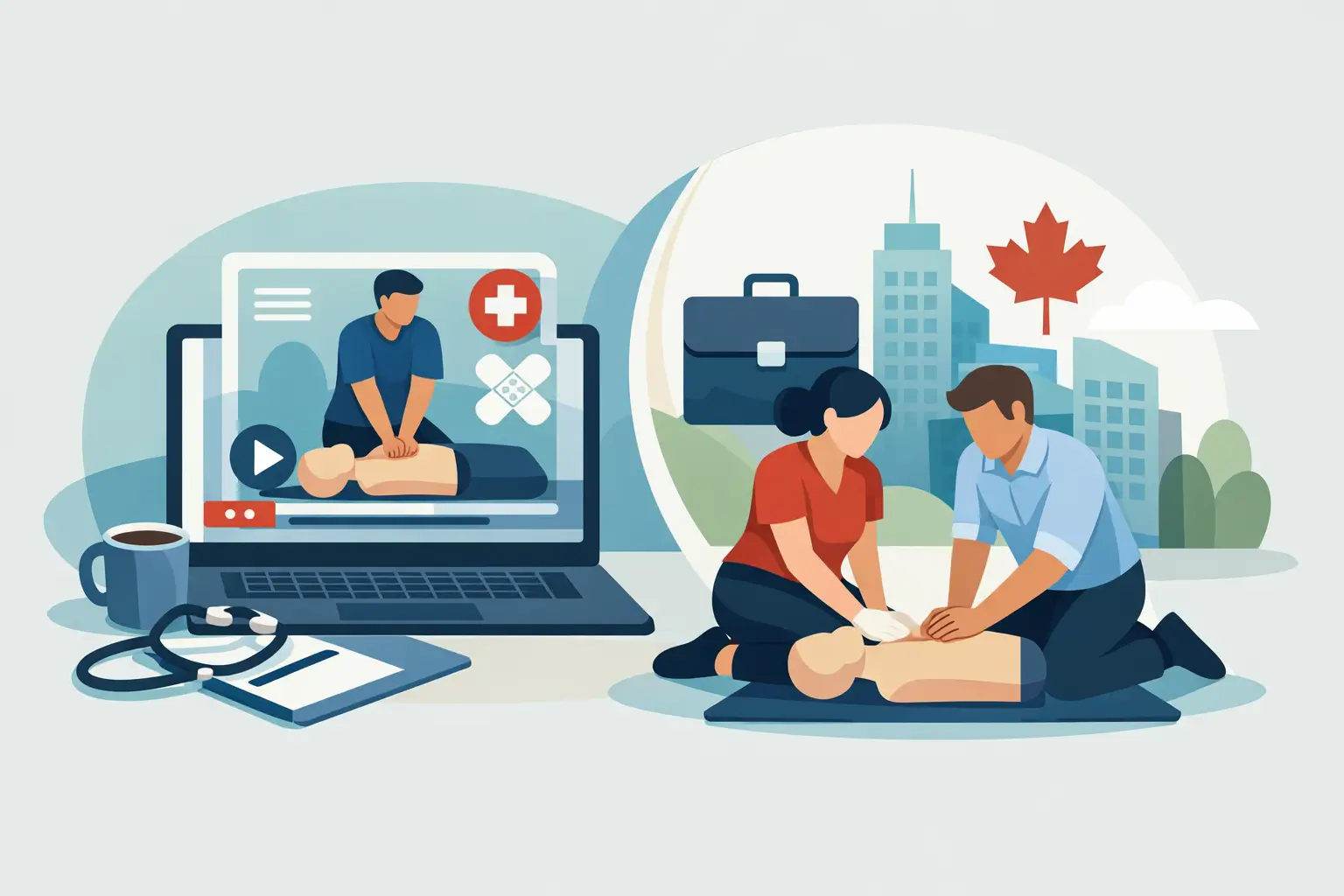
A job posting says “first aid and CPR required,” and the course you found has an online portion. The practical question is: is blended first aid valid for jobs? In Ontario, it can be, provided the course meets the employer’s stated requirement and is delivered through a recognized workplace first aid training provider.
The format alone does not decide whether a certificate is acceptable. What matters is the certification level, the training provider’s recognition status, the required in-person skills assessment, and the specific standard your employer or industry must follow. A legitimate blended course is not simply an online certificate. It combines online knowledge learning with hands-on instruction and evaluation.
When blended first aid is accepted for employment
Many Ontario employers accept blended first aid and CPR certification when the course is WSIB-recognized and includes all mandatory in-person training. This is especially relevant for employers that need workers to meet provincial workplace first aid obligations.
For a blended program to be suitable for a job, the learner should complete both parts of the course. The online component covers theory such as emergency scene management, legal responsibilities, CPR steps, AED use, bleeding control, and recognizing medical emergencies. The in-person session is where an instructor evaluates practical skills, including CPR quality, AED operation, choking response, wound care, and scenario-based decision-making.
That hands-on component is the difference between a recognized blended certification and an online-only completion record. Employers commonly need proof that the worker has practiced and been assessed on physical first aid skills, not just read course material or passed an online quiz.
A blended Intermediate First Aid Level C with AED course is often a practical option for employees, job seekers, supervisors, and security personnel. It reduces classroom time while maintaining the in-person instruction required to demonstrate competency.
Is blended first aid valid for jobs with WSIB requirements?
For Ontario workplaces, WSIB recognition is one of the clearest indicators to check. Employers covered by Ontario workplace first aid requirements need workers trained through providers that meet the applicable WSIB standards. A certificate from a recognized provider gives employers documentation that is aligned with those workplace expectations.
This does not mean every job requires the same course. The employer’s first aid plan, workplace size, risk level, and staffing arrangement can affect how many trained workers are required and what level of training is appropriate. A posting may ask generally for “first aid and CPR,” while another may specifically require Standard First Aid, Intermediate First Aid, CPR Level C, AED training, or a certificate from a named organization.
Before registering, read the posting carefully. If it states a required certification level, match that wording. If it does not, ask the hiring manager or employer whether a WSIB-recognized blended Intermediate First Aid Level C with AED certificate meets their requirement. That simple confirmation prevents enrolling in a course that is either below the required level or more extensive than necessary.
What makes a blended certificate legitimate?
A valid employment certificate should be easy for both the learner and employer to verify. It should identify the course level, CPR level, AED content where applicable, training date, expiry date, provider, and participant name. The course should also have a defined in-person practical session led by a qualified instructor.
Be cautious with courses marketed as “100% online” if the job requires workplace-recognized first aid training. Online learning may be useful for awareness, refresher knowledge, or internal education, but it is not automatically equivalent to a hands-on workplace certificate. First aid is practical by nature. An employer needs confidence that the certificate holder can position a patient, perform compressions, use an AED, apply a bandage, and respond under pressure.
The delivery method must also follow the training provider’s approved structure. In a properly designed blended course, online hours are not optional pre-reading. They are a required part of the program, followed by a scheduled classroom component that completes the certification process.
At Canada First Aid, the blended Intermediate First Aid Level C with AED format combines eight hours of online coursework with eight hours of in-person instruction. This structure gives participants flexibility for the knowledge portion while preserving the supervised practical training that workplace certification requires.
The employer can set a higher standard
A WSIB-recognized blended certificate is widely useful, but acceptance still depends on the employer. Some organizations have internal policies that go beyond the minimum workplace requirement. Hospitals, schools, child care environments, industrial sites, security contractors, and public-facing roles may require a particular course level, a particular certifying body, or recent training completed within a shorter time frame.
Security roles are a good example. A security company may accept a recognized first aid and CPR certificate for licensing or assignment purposes, while a specific client site may require additional training, such as naloxone response, use of personal protective equipment, or site-specific emergency procedures. First aid certification remains valuable, but it does not replace every employer-specific qualification.
Similarly, a job may require CPR Level C because the role involves children, families, or public contact. Another may require only emergency first aid because the worker’s duties and workplace coverage are limited. The correct course is the one that meets the stated requirement without leaving gaps in compliance.
How to check whether a course will work for your job
Do not rely only on a course title or a low advertised price. Confirm the details before you pay. You should be able to answer four questions:
- Is the provider recognized for the workplace certificate my employer requires?
- Does the course include the required first aid, CPR, and AED level?
- Is there an instructor-led, in-person practical evaluation?
- Will I receive a certificate that shows the course level and expiry date?
If you are already employed, ask your supervisor, health and safety representative, or human resources contact for the exact requirement. If you are applying for work, send a short question before registering: “Will a WSIB-recognized blended Intermediate First Aid Level C with AED certificate meet the requirement for this role?”
Keep the reply if you receive one. It gives you a clear record of what the employer confirmed and can be useful if the job requirement changes during onboarding.
Certificate timing and renewal matter
A valid course taken too early can still create a problem if the certificate expires before you begin work or complete onboarding. In Ontario, workplace first aid certificates are generally valid for three years, but employers can require more frequent renewal or specify a certificate that remains valid through the full term of employment.
Plan around hiring dates, orientation, and placement deadlines. If an employer needs proof before a start date, make sure you can complete both the online and in-person portions in time. Registering for the online component is not the same as holding the final certificate. Certification is issued only after all required course components and assessments are successfully completed.
Also check whether a refresher course is available and whether you qualify for it. Refresher eligibility often depends on holding a current, unexpired certificate at the appropriate level. Letting a certificate lapse may mean taking the full course again.
Blended learning is practical, not a shortcut
Blended first aid works well for people balancing shifts, job searches, family responsibilities, or a busy work schedule. The online section lets participants complete foundational content before class, while the in-person session focuses on skill practice, instructor feedback, and assessment.
The trade-off is that learners must manage the online portion responsibly. You still need to complete the coursework by the required deadline, attend the practical session, participate fully, and demonstrate the required skills. It is an efficient route to recognized training, not a way to avoid the hands-on part.
For employment purposes, choose a course based on the requirement behind the job posting, not just the format. A WSIB-recognized blended course with required in-person instruction can be valid for jobs across Ontario, but confirming the employer’s exact expectation before enrollment is the most reliable way to protect your time, your money, and your eligibility to work.