Best First Aid Course for Security Guards
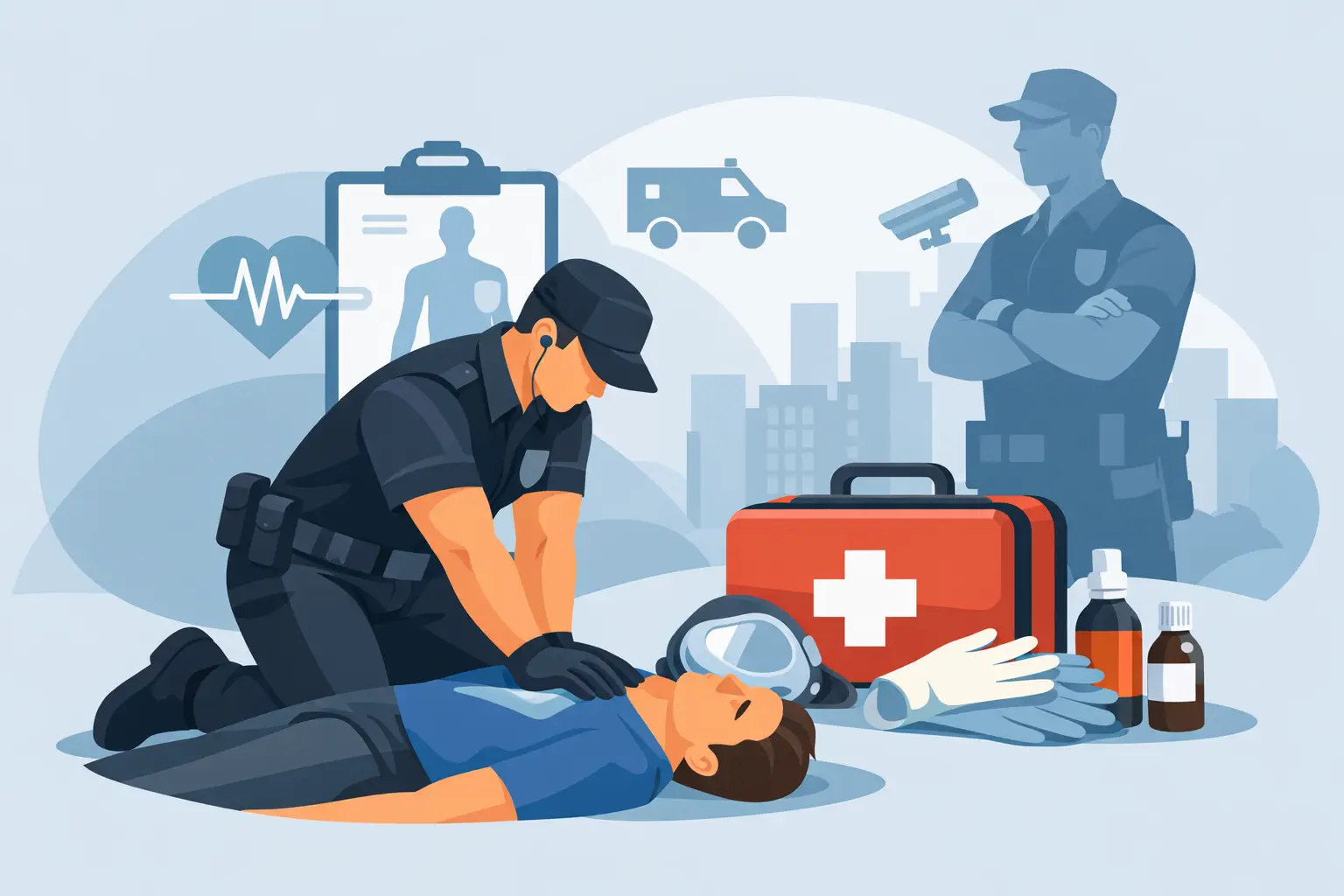
A security guard may be the first person on scene when a visitor collapses, a worker is injured, or an incident turns medical before emergency services arrive. The best first aid course for security guards is not simply the shortest course available. It must give the guard a recognized credential, practical response skills, and training that holds up to employer, site, and workplace requirements.
For many guards in Ontario, Intermediate First Aid with CPR Level C and AED training is the right standard. It is designed for workplace emergencies, covers a broader range of medical and injury scenarios than basic CPR alone, and provides a credential employers can assess clearly during hiring and contract onboarding.
What security guards need from first aid training
Security work is unpredictable. Guards may work alone, manage public-facing spaces, patrol construction sites, monitor residential buildings, or respond to incidents in retail, health care, industrial, and event settings. The medical risk changes by site, but the need to recognize an emergency, protect the scene, call for help, and provide care until responders arrive remains consistent.
A suitable course should prepare a guard to assess a scene without creating additional risk. That includes using personal protective equipment, directing bystanders, communicating with dispatch or 911, and documenting what happened according to site procedure. First aid is only one part of an effective security response. It must fit alongside incident reporting, access control, de-escalation, and emergency communication protocols.
CPR Level C is especially relevant because guards interact with adults, children, and infants depending on the location. AED training matters for the same reason. Automated external defibrillators are common in large facilities, schools, gyms, offices, and public venues, but equipment alone does not help unless the person responding knows how to use it promptly and safely.
Best first aid course for security guards: the practical choice
For most security guards seeking a workplace-ready credential, Intermediate First Aid Level C with AED certification is the strongest fit. It combines CPR and AED skills with first aid training for injuries and medical emergencies that may occur during a shift.
The course is more comprehensive than a CPR-only class. In addition to responding to cardiac arrest, participants generally practice how to manage bleeding, shock, choking, burns, fractures, head and spinal concerns, sudden medical conditions, and environmental emergencies. The exact curriculum and certification requirements should always be confirmed before registration, particularly when an employer or contract specifies a provider or course level.
Intermediate First Aid is often the better choice when a guard works at a site with higher public traffic, physical hazards, lone-worker duties, or limited immediate access to on-site medical personnel. A guard assigned to a quiet concierge desk may have different day-to-day exposure than a guard at an industrial facility, but employers commonly prefer a credential that covers more than the minimum.
That does not mean every position requires the same course. Some employers request only CPR and AED certification. Others require a specific first aid level, a particular recognized training organization, or a certificate that remains valid for a stated period. Review the job posting, ask the employer before booking, and keep a record of any site-specific training requirement. Choosing a course first and checking later can lead to paying twice.
Recognition matters as much as the course title
A course title alone does not prove that a certificate will meet workplace expectations. Security guards should look for training that is recognized for the purpose they need, especially when the certification supports an Ontario job, a client contract, or workplace compliance requirement.
WSIB-recognized first aid training is a practical consideration for Ontario workplaces. Recognition helps employers verify that training aligns with provincial workplace first aid expectations. It also gives job seekers a clearer credential to present during recruitment and onboarding.
Before enrolling, confirm four details:
- The exact certificate name, including the CPR and AED component.
- Whether the course is recognized for the employer or workplace requirement.
- The certificate validity period and any required renewal process.
- Whether the training includes an in-person skills assessment.
These details are more useful than vague claims that a course is "approved" or "accepted everywhere." Requirements can vary by employer, work location, client contract, and role. A professional course provider should state what certification is issued and what the learner must complete to receive it.
Why hands-on training cannot be skipped
Security personnel do not need first aid knowledge only on paper. They need to perform under pressure while protecting themselves, the injured person, and the surrounding area. That is why practical skills training is essential.
During an in-person session, participants can practice chest compressions, AED use, recovery position, choking response, bandaging, bleeding control, and scenario-based decision-making. An instructor can correct hand placement, compression depth, communication, and scene management in a way an online module cannot.
Online learning still has a place. It can cover first aid principles, emergency response steps, legal considerations, and knowledge checks efficiently. A blended format works well for guards with rotating schedules because theory can be completed before attending the practical session. However, fully online first aid courses may not meet an employer's hands-on training expectation. If the credential is needed for work, verify the delivery format before paying.
Canada First Aid offers Intermediate First Aid Level C with AED certification through a blended format: eight hours of online coursework followed by eight hours of in-person instruction. This structure gives learners time to complete theory efficiently while preserving the practical assessment required for real emergency response skills.
Match the course to the security assignment
The right training decision starts with the actual post, not just the job title. A guard at a commercial office tower may need to respond to a medical emergency in a lobby while directing arriving paramedics. A mobile patrol guard may be alone when encountering an injured person. Event security may need to manage crowds, heat-related illness, intoxication, or trauma until medical teams take over.
Consider the environment, the likely people on site, and the time required for emergency responders to arrive. Guards working around children or families benefit from Level C training because it includes CPR skills across age groups. Guards at construction, warehouse, manufacturing, or outdoor sites may face increased risk of bleeding, fractures, heat illness, or falls. Public-facing guards need the same medical skills, but must also maintain scene control and clear communication.
A first aid course does not replace site emergency procedures. Guards should know where the first aid kit, AED, emergency exits, muster points, and incident forms are located. They should also understand when to contact 911, when to notify a supervisor, and when to avoid moving an injured person. The certificate is the foundation. Site orientation makes it operational.
Compare courses without choosing on price alone
Cost and scheduling matter, particularly for guards paying for certification before starting a role. But the lowest listed price is not always the lowest total cost. A course may exclude CPR, AED training, taxes, certificate fees, practical assessment, or a required renewal component. It may also require additional travel or time off work.
Compare the complete training package: course level, recognition, delivery method, total training hours, in-person location, certificate issue process, and schedule availability. A blended course can reduce the number of hours spent away from work or commuting while still providing practical instruction.
Be cautious with courses that promise instant certification with little or no skills practice. Security employers need personnel who can respond competently, not simply show a digital completion record. A legitimate program should make the course requirements, attendance expectations, and certification outcome clear before registration.
Prepare to use the training on shift
After certification, keep a current copy of the credential available for employer onboarding and renew it before it expires. More importantly, review the core response sequence regularly: check scene safety, assess responsiveness and breathing, call for emergency assistance, provide appropriate care, and communicate clearly with responders and supervisors.
Confidence comes from knowing your role. A security guard is not expected to diagnose injuries or replace paramedics. The job is to recognize the emergency, start appropriate first aid within the scope of training, maintain a safe scene, and support a fast handoff to emergency services. Choose training that prepares you for that responsibility before the next incident makes the decision for you.