How to Help Choking Adults in an Emergency
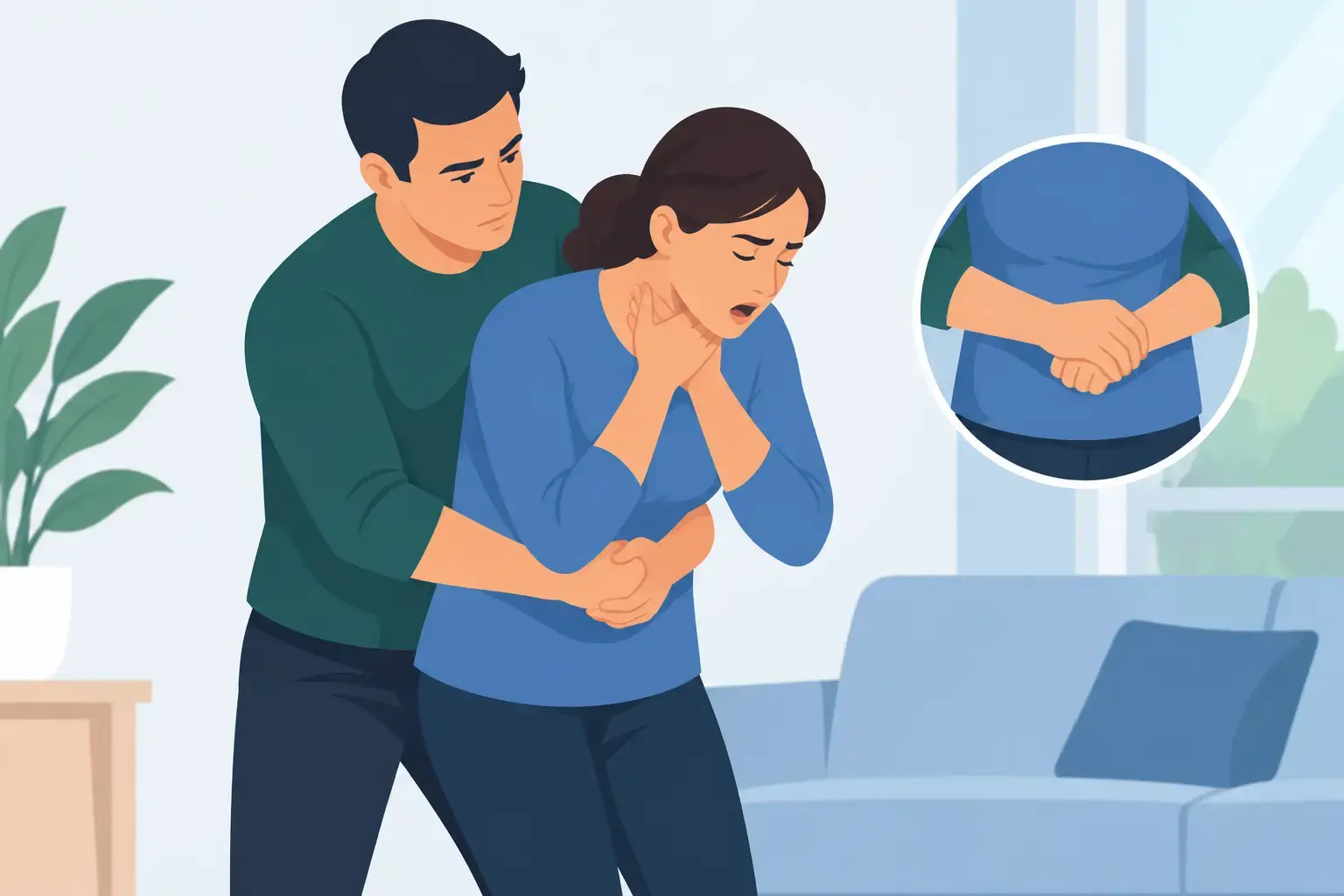
A choking emergency can become life-threatening in minutes. Knowing how to help choking adults means recognizing a blocked airway quickly, calling 911 without delay, and using the correct first aid response until the object is expelled or emergency services take over.
First, determine whether the airway is blocked
Ask the person, “Are you choking?” If they can speak, cough forcefully, or breathe, air is still moving. Encourage them to keep coughing and stay with them. Do not slap their back or give them water while they are coughing effectively. Their cough is the best way to clear a partial blockage.
Treat the situation as a severe airway obstruction when the person cannot speak, breathe, or cough effectively. They may clutch their throat, make little or no sound, look panicked, or develop bluish lips or skin. A person with a severe blockage needs immediate help.
Call 911, or direct a specific bystander to call. If others are present, assign clear tasks: one person calls 911, another brings an AED if one is available, and another stays nearby to assist. Do not leave the choking person alone to look for equipment.
How to help choking adults who are conscious
For a conscious adult with a severe airway blockage, alternate five back blows with five abdominal thrusts. Continue until the object comes out, the person can breathe or cough effectively, or they become unresponsive.
Give five firm back blows
Stand slightly to the side and behind the person. Support their chest with one hand and lean them forward so the object is more likely to come out of the mouth instead of moving deeper into the airway.
Use the heel of your other hand to deliver five firm blows between the shoulder blades. Check after each blow to see whether the blockage has cleared. The goal is to remove the object, not simply complete a set of five blows.
Give five abdominal thrusts
If the back blows do not clear the airway, stand behind the person and wrap your arms around their waist. Make a fist and place the thumb side just above the belly button and well below the breastbone. Grasp your fist with your other hand.
Give five quick inward-and-upward thrusts. Each thrust should be separate and controlled. Reassess after each one. If the person is still unable to breathe, repeat the cycle of five back blows and five abdominal thrusts.
Do not perform abdominal thrusts on someone who is pregnant or whose body size prevents you from reaching around their abdomen safely. Use chest thrusts instead. Place your hands on the center of the breastbone and give quick, firm inward thrusts. Avoid pressure on the ribs and do not place your hands over the lower tip of the breastbone.
Actions that can make choking worse
Do not put your fingers into the person’s mouth unless you can clearly see the object and can remove it easily. A blind finger sweep can push the object farther into the throat or cause injury.
Do not offer food, water, or medication. Do not tell the person to lie down while they are conscious. Keep them upright and continue the choking response until they recover or lose consciousness.
Avoid stopping just because the person appears briefly calmer. A partial obstruction can worsen, and a person who has expelled an object may still have throat irritation, pain, or another object remaining in the airway.
If the choking adult becomes unresponsive
If the person becomes unresponsive, lower them carefully to the ground. Call 911 if this has not already been done, or have someone else call. If you are alone, call on speakerphone so you can begin care without delay.
Start CPR. Place the heel of one hand in the center of the chest, place your other hand on top, and give 30 chest compressions. Push hard and fast, allowing the chest to fully rise between compressions. For most adults, compress at a rate of 100 to 120 compressions per minute.
After 30 compressions, open the airway and look inside the mouth. If you see the object, remove it carefully. If you do not see an object, do not sweep with your fingers. Give two rescue breaths if you are trained and willing to do so, then return to compressions.
Each set of compressions may help dislodge the object. Continue CPR until the person begins breathing, an AED is ready to use, trained responders take over, or you are physically unable to continue.
Use an AED as soon as one arrives
An AED may be needed if the person becomes unresponsive and does not show signs of normal breathing. Turn it on immediately and follow its voice prompts. Expose the chest, attach the pads as shown on the device, and make sure no one is touching the person during analysis or when a shock is advised.
Do not delay CPR while waiting for an AED. If another trained person is present, one rescuer can continue compressions while the other prepares the device.
What to do if you are choking alone
Call 911 immediately if you can. If you are unable to speak, use your phone’s emergency call feature if available. Then perform abdominal thrusts on yourself by making a fist, placing it above your belly button, and pressing inward and upward.
You can also lean forcefully over the back of a sturdy chair, counter edge, or similar firm surface positioned above the belly button. Use controlled pressure to create an inward-and-upward thrust. Continue until the object comes out or help arrives.
If you are pregnant or cannot use abdominal thrusts, use quick inward chest thrusts against a firm surface at the center of the breastbone.
After the object is expelled
Even when the person feels better, the event may require medical follow-up. Abdominal or chest thrusts can cause bruising or internal injury, especially in older adults or people with existing medical conditions. Seek medical assessment if the person has ongoing coughing, trouble swallowing, chest or abdominal pain, hoarseness, breathing difficulty, or a persistent sensation that something remains in the throat.
If the person becomes unresponsive at any point, has no normal breathing, or does not fully recover after the object is removed, emergency evaluation is required.
Training makes the response more reliable
Reading the steps helps, but choking emergencies are stressful and fast-moving. Hands-on first aid and CPR training gives you the chance to practice body position, back blows, abdominal thrusts, chest thrusts, CPR, and AED use under instructor guidance.
For Ontario employees, supervisors, security personnel, and workplace teams, a recognized first aid course also supports a more prepared response when an emergency occurs before paramedics arrive. Canada First Aid provides blended Intermediate First Aid Level C with AED training for people who need practical emergency skills alongside recognized certification.
In a real choking emergency, act early, use the correct technique, and keep going until the person can breathe or emergency responders take over. Calm, direct action can give someone the time they need to survive.