AED Training: What Certification Should Cover
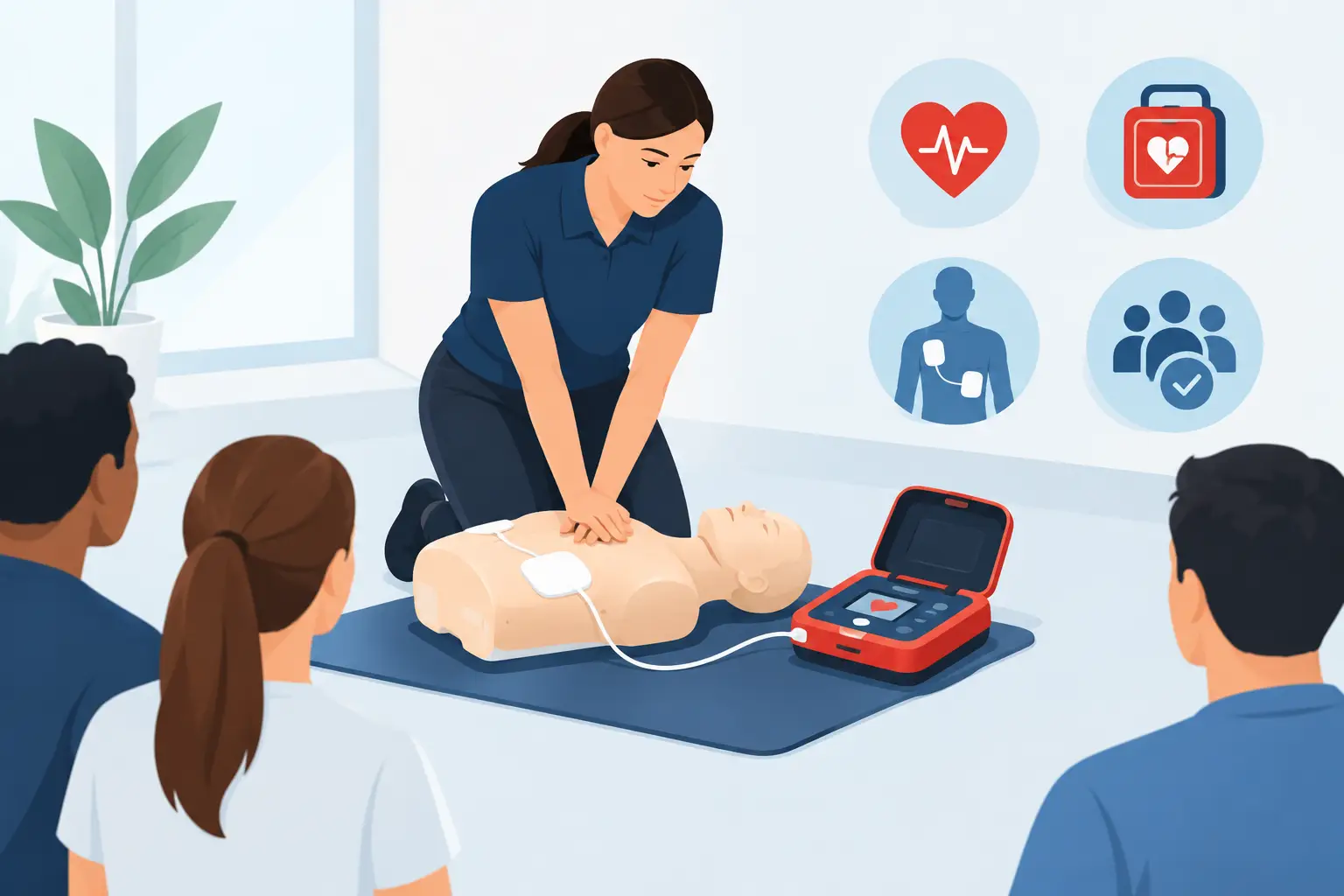
An AED may be mounted on a wall, but it becomes useful only when someone can recognize a cardiac emergency, act quickly, and use the device without hesitation. AED training gives participants the practical sequence behind that response: assess the scene, call for help, begin CPR, apply the pads, and follow the device prompts until emergency services take over.
For employees, supervisors, security personnel, and job seekers, this is not simply a box to check. A recognized course can meet an employer's first aid requirement while giving the learner a clear, repeatable process for one of the most time-sensitive emergencies they may face.
What AED Training Actually Teaches
An automated external defibrillator, or AED, analyzes a person's heart rhythm and may advise a shock when a shockable rhythm is detected. The device is designed to give voice and visual prompts, but those prompts do not replace first aid judgment. A trained responder still needs to identify unresponsiveness, check for normal breathing, activate emergency response, and start high-quality CPR.
A proper course teaches AED use as part of a complete cardiac-arrest response. Participants should learn how to expose and dry the chest, place adult pads correctly, make sure no one is touching the patient during analysis or shock delivery, and resume CPR immediately when directed. Training should also address how to manage a wet environment, chest medication patches, excessive chest hair, implanted medical devices, and pediatric patients when appropriate equipment is available.
The point is not to memorize a brand-specific machine. Most AEDs follow a similar operating flow. The goal is to build the confidence to respond to the prompts safely while continuing effective CPR and coordinating with bystanders.
Why Hands-On Practice Matters
Online coursework can explain the sequence, but practical skills need to be observed and practiced. During an in-person session, an instructor can correct hand placement, compression depth and rate, pad positioning, and the timing of CPR interruptions. Those details matter because a real emergency will not feel like a multiple-choice question.
Practice also helps learners work through common delays. Someone may worry about hurting the patient, wait too long for a pulse check, or forget to clearly tell others to stand clear. Repeating the process with a training manikin and AED trainer makes the steps more automatic.
Blended learning is often a practical choice for working adults. It allows participants to complete theory at a manageable pace before attending a focused classroom session for skill practice and evaluation. For a course to be meaningful, however, the in-person portion must be more than attendance. Learners should demonstrate the required CPR and AED skills under instructor supervision.
AED Certification and Workplace Requirements
The certification an employer needs depends on the role, workplace hazard level, and applicable provincial requirements. In Ontario, workplaces may require first aid training that meets Workplace Safety and Insurance Board, or WSIB, standards. An AED component is commonly included with CPR training because early defibrillation is a central part of responding to sudden cardiac arrest.
Employers should avoid assuming that any short AED course will meet a formal workplace requirement. A certificate may be useful for awareness, yet not satisfy a role that requires a recognized first aid and CPR credential. Before registering, confirm the exact certification level requested by the employer, contract, client site, or licensing body.
For many Ontario workplaces, Intermediate First Aid with CPR Level C and AED certification is a practical option. It covers broader first aid skills alongside adult, child, and infant CPR and AED response. This can be especially relevant for supervisors, security staff, designated first aid attendants, and workers who may need to respond before paramedics arrive.
Certification also has a renewal date. Course providers and employers may set policies based on the credentialing standard, so participants should check the expiry date on their certificate and schedule recertification before it lapses. Waiting until a credential has expired may mean a full course is required rather than a shorter renewal option.
What to Confirm Before You Register
Choosing a course based only on price or advertised duration can create problems later. The course should match the reason you need it, whether that is workplace compliance, a job application, a client requirement, or personal preparedness.
Before enrolling, confirm these points:
- The issuing organization and whether the credential is recognized for your workplace requirement.
- The first aid and CPR level included, including whether CPR Level C and AED certification are part of the course.
- The delivery format, including the required online hours and in-person practical session.
- The course location, schedule, completion requirements, and certificate issuance process.
- The recertification eligibility rules and the validity period of the certificate.
These details are particularly important when a deadline is involved. A job offer, security contract, or workplace assignment may require proof of current certification before a start date. Ask whether the course is available in time, how completion is documented, and whether there are prerequisites for recertification.
AED Training for Security and Public-Facing Roles
Security personnel, building staff, recreation employees, retail supervisors, and front-line workers are often among the first people available when an emergency occurs. Their role is not to diagnose a medical condition. It is to recognize an urgent situation, activate the appropriate response, and provide care within the scope of their training.
In a public setting, the first minutes can be disorganized. One person may call 911, another may retrieve the AED, and another may guide emergency responders to the location. AED training prepares participants to communicate clearly, assign simple tasks, and keep care moving while help is on the way.
This is also why scenario-based practice has value. Responding in a quiet classroom is different from responding in a lobby, warehouse, construction site, or crowded event space. A competent learner understands that scene safety comes first. If there is ongoing violence, traffic, fire, electrical danger, or another uncontrolled hazard, the responder must not enter until it is safe to do so.
The Response Sequence to Remember
The exact direction of emergency dispatchers and the AED should always be followed. Still, a clear basic sequence helps trained responders act without losing time.
First, make sure the scene is safe. Check whether the person is responsive and breathing normally. If they are unresponsive and not breathing normally, call 911 or direct someone else to call. Send another person to get the AED if one is available.
Begin CPR as soon as possible. Turn on the AED when it arrives, expose the chest, and apply the pads as shown on the diagrams. Follow every prompt, ensuring that no one touches the patient during rhythm analysis and shock delivery. Resume CPR immediately after the AED advises it, and continue until the person shows signs of life, emergency responders take over, or the scene becomes unsafe.
A responder does not need perfect conditions to begin. They need to start with the safest available action, use the resources at hand, and keep following the established sequence.
Choosing a Blended Course in Ontario
A blended format can reduce time away from work without removing the practical component that makes certification credible. Canada First Aid offers Intermediate First Aid Level C with AED certification through eight hours of online coursework and eight hours of in-person instruction. This structure gives participants time to complete knowledge-based material before demonstrating hands-on skills in class.
For employers, the format can make scheduling more manageable across shifts and teams. For individuals, it provides a direct path to a recognized credential without treating first aid as a purely online exercise. The right course is the one that satisfies the required standard and leaves the participant able to respond calmly when seconds matter.
A current certificate is useful for employment records. The ability to recognize cardiac arrest, start CPR, and use an AED while waiting for emergency services is what gives that certificate its real value.