How to Use a Workplace AED in an Emergency
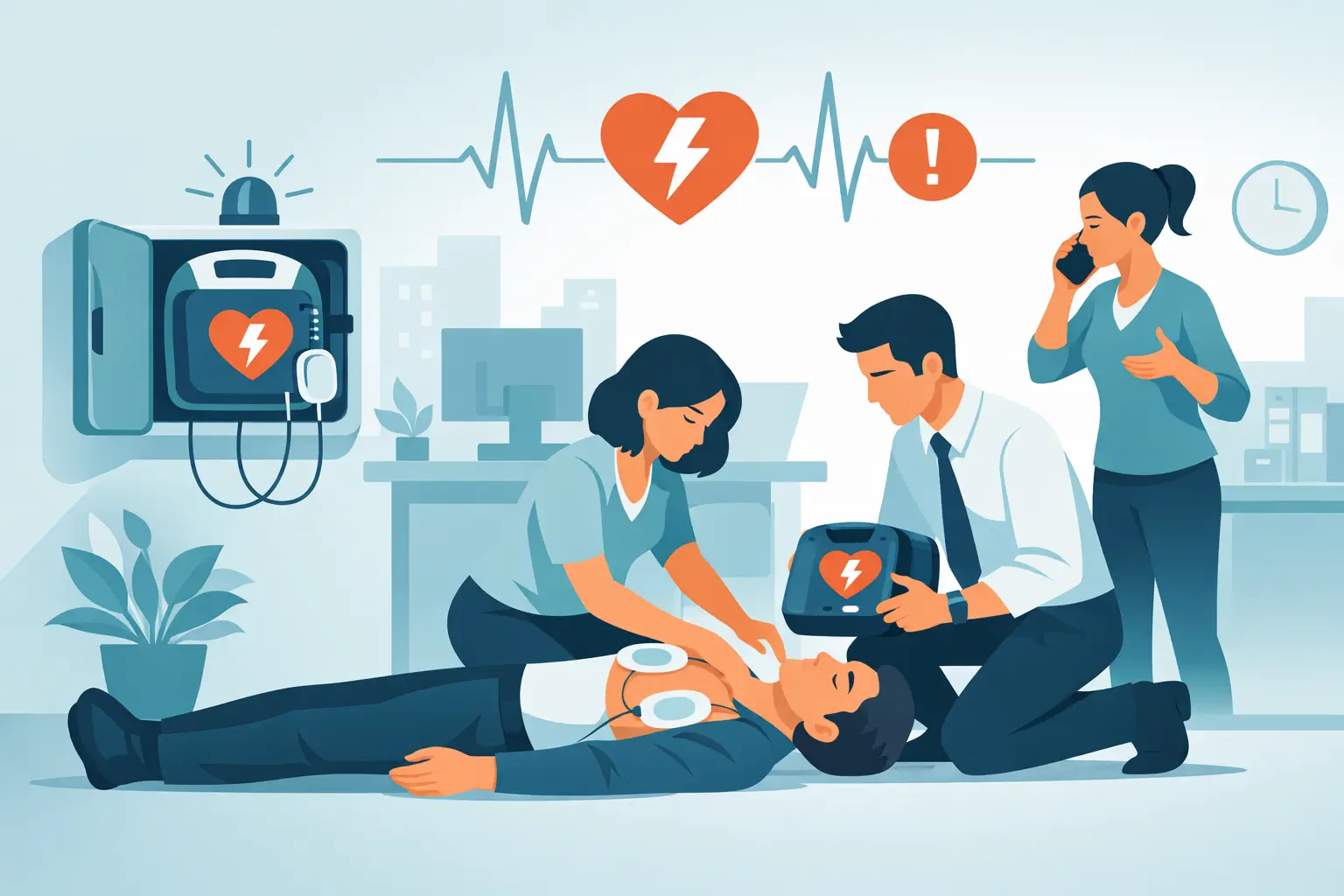
A workplace cardiac arrest is not the time to search for instructions, assign blame, or wait for a supervisor to arrive. If an adult suddenly collapses, is unresponsive, and is not breathing normally, the priority is immediate action: call 911, start CPR, and bring the AED to the person without delay.
Learning how to use workplace AED equipment is part of a broader emergency response plan. The device gives voice and visual prompts, but an effective response also depends on quick recognition, clear communication, safe pad placement, and continuous CPR. Staff do not need to diagnose the cause of collapse before acting.
Recognize when an AED is needed
Use an AED when a person is unresponsive and not breathing normally. Occasional gasps, irregular snorting sounds, or very slow agonal breaths are not normal breathing. Treat the situation as cardiac arrest unless there is a clear reason not to.
First, check that the area is safe for you, the person, and bystanders. Tap the person's shoulders and speak loudly: "Are you okay?" If there is no response, call for help immediately. If other employees are nearby, direct them with specific instructions rather than making a general request.
Tell one person to call 911 and return to confirm the call was made. Tell another person to bring the workplace AED and first aid kit. If you are alone, call 911 on speakerphone if possible, then begin CPR and retrieve the AED as soon as it is available.
Do not spend more than a few seconds checking for a pulse unless you are trained and confident in doing so. A delayed response can reduce the chance of survival. When in doubt, begin CPR and follow the AED prompts.
How to use a workplace AED step by step
An AED, or automated external defibrillator, analyzes the heart's rhythm and advises whether a shock is appropriate. It will not deliver a shock unless it detects a shockable rhythm. That built-in analysis makes AEDs suitable for trained workplace responders and, in an emergency, for any willing bystander following the device instructions.
Start CPR while the AED is being retrieved
Place the person flat on their back on a firm surface. Put the heel of one hand in the center of the chest, place your other hand on top, and keep your arms straight. Push hard and fast at a rate of 100 to 120 compressions per minute, allowing the chest to fully recoil after each compression.
For adults, compress at least 2 inches deep while avoiding excessive depth. If you are trained in rescue breaths, provide 30 compressions followed by 2 breaths. If you are not trained, unwilling, or unable to give breaths, provide continuous chest compressions. The key is to minimize interruptions.
Turn on the AED immediately
As soon as the AED arrives, place it beside the person's head or upper body and turn it on. Some units activate when the lid is opened; others have a clearly marked power button. Follow the device's voice prompts exactly.
One responder should continue chest compressions while another prepares the AED whenever possible. This reduces the time without circulation. If you are the only responder, pause compressions only as long as necessary to expose the chest and attach the pads.
Expose and prepare the chest
Remove or cut away clothing from the person's chest. The AED pads must adhere directly to bare, dry skin. If the chest is wet from water, sweat, or snow, dry it quickly with a towel or cloth. Do not delay pad placement for minor moisture once the area is sufficiently dry.
If the person has a medication patch where a pad should be placed, remove the patch using gloves if available and wipe the area before applying the pad. If there is a visible implanted pacemaker or defibrillator, usually felt as a small hard lump under the skin below the collarbone, place the AED pad at least 1 inch away from it. Do not place a pad directly over the device.
Excessive chest hair can prevent pads from sticking. Use the razor from the AED kit if one is provided, but only shave the area needed for pad contact. If the first set of pads will not adhere, use a second set if available. Avoid spending unnecessary time on preparation while CPR is paused.
Apply the pads as shown
Remove the backing from the pads and follow the diagram printed on them. For most adults, place one pad on the upper right side of the bare chest, below the collarbone. Place the second pad on the left side of the chest, below and to the side of the armpit.
Press each pad firmly against the skin and connect the pad cable to the AED if it is not already connected. Pediatric pads or a pediatric setting should be used for children when available and appropriate. If only adult pads are available in an emergency, follow the AED manufacturer's instructions and your training.
Stand clear during analysis
Once the AED instructs you to stop CPR for analysis, make sure no one is touching the person. State clearly, "Stand clear," and visually check the scene. Movement can interfere with the analysis.
The AED will announce either that a shock is advised or that no shock is advised. Do not remove the pads after an analysis. Keep them in place until emergency medical services take over or the person shows clear signs of recovery.
Deliver a shock only when advised
If the AED advises a shock, make sure everyone is clear of the person. Look over the person's body and confirm no one is in contact with them, including anyone touching a bed, stretcher, or conductive surface connected to them.
If your AED requires you to press a shock button, press it only after confirming the area is clear. Some models deliver the shock automatically after a warning. Immediately resume CPR when the AED tells you to do so, starting with chest compressions. Do not stop to check for a pulse or wait to see whether the person wakes up.
If no shock is advised, resume CPR immediately. A non-shockable rhythm still requires urgent care and continuous CPR. The AED will analyze again at intervals and provide further instructions.
Manage common workplace conditions safely
Most workplaces are not ideal treatment settings. A person may collapse in a lobby, warehouse, lunchroom, parking lot, or construction area. The basic response remains the same, but scene hazards must be controlled.
If the person is in standing water, move them to a dry area if it can be done quickly and safely. Do not use the AED in flammable or oxygen-enriched environments until the hazard is controlled. Move loose oxygen sources away from the chest area if they are present, but do not delay emergency care over a minor concern.
For a pregnant person, use the AED normally. For someone wearing a bra with metal underwire, remove it if it interferes with pad placement. Jewelry usually does not need to be removed unless it is directly in the pad location.
When multiple responders are present, assign roles: one person calls 911 and meets emergency crews, one performs CPR, one operates the AED, and one manages the surrounding area. In a large workplace, someone should also direct responders from the entrance to the exact location. Those minutes matter.
After the AED is used
Continue CPR and follow device prompts until paramedics take over, the person begins breathing normally and shows signs of life, or you are physically unable to continue. If the person starts breathing normally but remains unresponsive, place them in the recovery position if there is no concern for spinal injury, monitor them closely, and leave the pads attached.
After the incident, preserve the AED for emergency medical services or workplace review. Do not erase its data. The device may contain information that helps clinicians understand the event. Record the time of collapse if known, when 911 was called, when CPR began, and when the AED was attached or shocks were delivered.
The workplace should restock used pads, batteries, gloves, razors, and barrier devices immediately. It should also document the incident under its internal reporting procedures and provide appropriate support to employees involved. Responding to cardiac arrest can be stressful even when the team acted correctly.
Keep the workplace AED ready before an emergency
An AED only helps if employees can locate it, access it, and use it without hesitation. The unit should be clearly marked, easy to reach, and not locked behind an office door or stored where only one person knows its location. Staff should know who checks the unit and how often.
Regular inspections should confirm that the status indicator shows the AED is ready, the pads and battery have not expired, the cabinet alarm functions if installed, and the response kit is complete. A posted emergency plan should identify who calls 911, who retrieves the AED, and who meets responders.
Formal first aid and CPR training gives employees the chance to practice compressions, AED setup, communication, and role assignment before a real event. For Ontario workplaces that need recognized credentials, Canada First Aid provides blended Intermediate First Aid Level C with AED training that combines online learning with practical in-person instruction.
A clear plan, a maintained AED, and people willing to act can turn a chaotic workplace emergency into an organized response. The right time to learn the device is before someone needs it.