CPR Level A versus C: Which Course Fits Your Role?
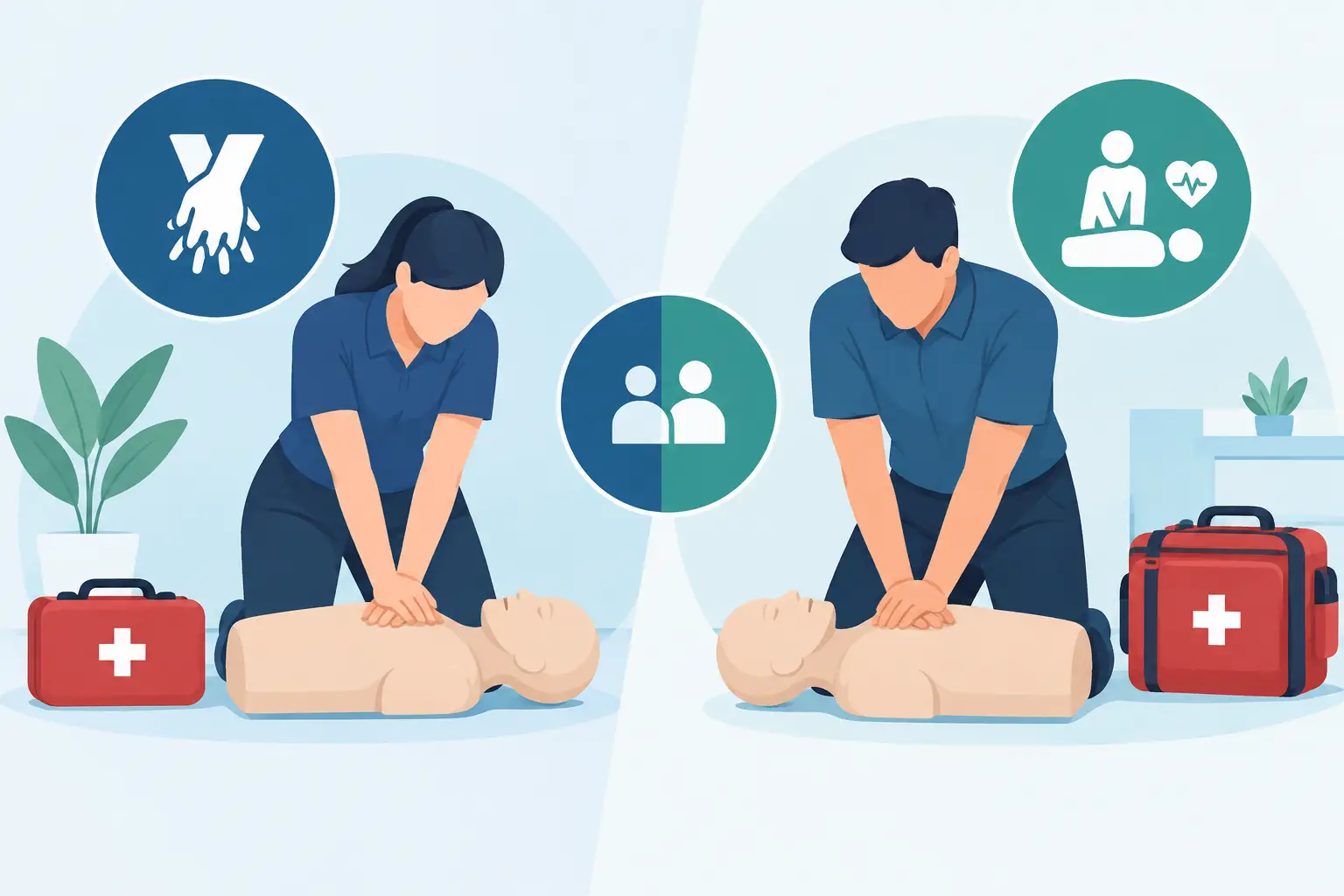
A job posting that says “CPR required” leaves out the detail that matters: which CPR level will the employer accept? The decision between CPR Level A versus C is not about choosing the harder course for its own sake. It is about learning the skills you may actually need and meeting the certification standard attached to your work, volunteer role, or workplace first aid plan.
For most people seeking employment in Ontario, CPR Level C is the more broadly accepted option. CPR Level A can be appropriate in narrower situations, but it does not prepare participants to respond to every age group. Before registering, check the exact wording of the employer's requirement, including whether AED training and a full first aid course are also required.
CPR Level A versus C: The Core Difference
CPR Level A focuses on adult resuscitation skills. It is designed for participants who need to respond to cardiac and breathing emergencies involving adults, generally in a one-rescuer setting. Training commonly includes adult CPR, choking response, and use of an automated external defibrillator, or AED, where included in the course standard.
CPR Level C covers a wider range of casualties: adults, children, and infants. Participants learn age-appropriate CPR and choking procedures, along with AED use. Because the techniques and equipment considerations differ by age and body size, Level C gives learners a broader response framework than Level A.
That difference is decisive for many workplaces. A school, child care setting, recreation program, security role, healthcare-adjacent position, or public-facing workplace may reasonably require training that includes children and infants. Even where children are not part of the regular environment, Level C is often requested because it is a more comprehensive CPR credential.
What CPR Level A Covers
Level A is not an inferior certification. It is a focused course for a focused need. If your responsibility is limited to adult emergencies, it can provide the relevant core knowledge without teaching pediatric skills you are unlikely to use at work.
A typical CPR Level A course addresses how to recognize cardiac arrest in an adult, call for emergency help, perform chest compressions and rescue breaths according to the course standard, respond to choking, and use an AED. Learners also practice responding safely, assessing an unresponsive person, and working within the limits of their training.
This level may suit an adult-only workplace where the employer specifically accepts Level A. It can also be appropriate for someone who wants basic adult CPR knowledge for personal preparedness. However, it should not be selected simply because it appears shorter or less demanding. If an employer asks for CPR Level C, Level A will not meet that requirement.
What CPR Level C Adds
Level C includes the adult skills covered in Level A, then extends the training to children and infants. This matters because a child or infant in distress cannot be treated as a smaller adult. Compression techniques, choking response, and the use of AED pads or settings must reflect the casualty's age and size.
The broader scope makes Level C the practical default for people whose work brings them into contact with the public, families, youth, or mixed-age groups. It is also commonly requested for security personnel, supervisors, fitness professionals, camp staff, teachers, and job seekers who want a credential that applies across more roles.
Level C does require learners to retain more procedures and demonstrate more skills. That is a reasonable trade-off for its wider application. If you may need to assist an adult, child, or infant, the additional training is directly relevant rather than optional.
Do You Need CPR Only or First Aid With CPR Level C?
This is where many registrations go wrong. CPR Level C is a CPR credential. It is not automatically the same as a recognized workplace first aid certification. An employer may ask for CPR Level C with AED, or it may require a first aid program that includes CPR Level C and AED certification.
A first aid course goes beyond resuscitation. It addresses how to assess and manage a range of injuries and medical emergencies, such as severe bleeding, fractures, burns, seizures, diabetic emergencies, poisoning, and environmental illness. The exact content and duration depend on the approved course standard.
For Ontario workplace requirements, the certification must match the employer's obligations and the training standard they have specified. Do not assume that any CPR card will satisfy a workplace requirement just because it includes AED practice. Ask the employer whether they require CPR only, Emergency First Aid with CPR/AED, or Intermediate First Aid with CPR/AED.
Canada First Aid offers Intermediate First Aid Level C with AED certification through a blended format that combines online coursework with in-person skills instruction. This type of format can be useful when a learner needs a recognized workplace credential while keeping in-class time focused on practical assessment and hands-on performance.
How to Choose the Right Course
Start with the requirement, not the course name. If you are registering for a job, request the employer's written training requirement. Phrases such as “Standard First Aid,” “Intermediate First Aid,” “CPR-C,” “AED,” and “WSIB-recognized” are not interchangeable. Each phrase may indicate a different credential or course component.
Next, consider who you may realistically need to assist. An office that serves adults only may accept CPR Level A. A condominium security team, community facility, retail location, school, or workplace with visitors of all ages is more likely to benefit from Level C. If your role can change or you are applying to several positions, Level C may reduce the chance that you need to retrain later.
Also confirm the training provider's certification details. A valid certificate should clearly identify the course completed, the CPR level, the certifying organization or standard, the issue date, and the expiry or recertification period where applicable. Employers need documentation they can verify, not a general statement that you have “taken CPR.”
Questions Employers and Job Seekers Should Ask
Employers should define the credential needed before directing staff to training. A vague instruction to “get CPR certified” can lead to employees enrolling in Level A when the workplace policy requires Level C with AED, or enrolling in CPR-only training when a full first aid course is required.
Job seekers should ask whether the certificate must be current at the time of application, at the time of hire, or before the first shift. They should also ask whether the employer accepts blended learning. In a properly structured blended course, online learning covers knowledge content and the in-person session verifies hands-on skills. Acceptance still depends on the employer's stated policy and the applicable certification standard.
Course duration, cost, and scheduling matter, but they should come after compliance. The least expensive course is not a saving if it does not meet the requirement. Likewise, a more comprehensive course is not automatically necessary when an employer has clearly confirmed that Level A is acceptable.
Common Mistakes to Avoid
The most common mistake is treating every CPR certificate as equivalent. Level A, Level C, AED training, and workplace first aid certifications have different scopes. Read the course description before payment, particularly when a job posting uses abbreviated language.
Another mistake is waiting until the last minute. In-person skills sessions and certification processing require scheduling. If your start date depends on a credential, register early enough to complete both the learning and practical components without rushing.
Finally, do not choose based on a friend’s experience or an old employer requirement. Course standards and workplace policies can change. The current requirement from your employer, licensing body, school, or placement coordinator is the one that controls.
If you are uncertain, ask the person requesting the certification to confirm the exact course title in writing. That one step can prevent a missed hiring deadline, an unnecessary second course, and the far more serious problem of being unprepared when someone needs help.