How to Pass CPR Level C: What Evaluators Check
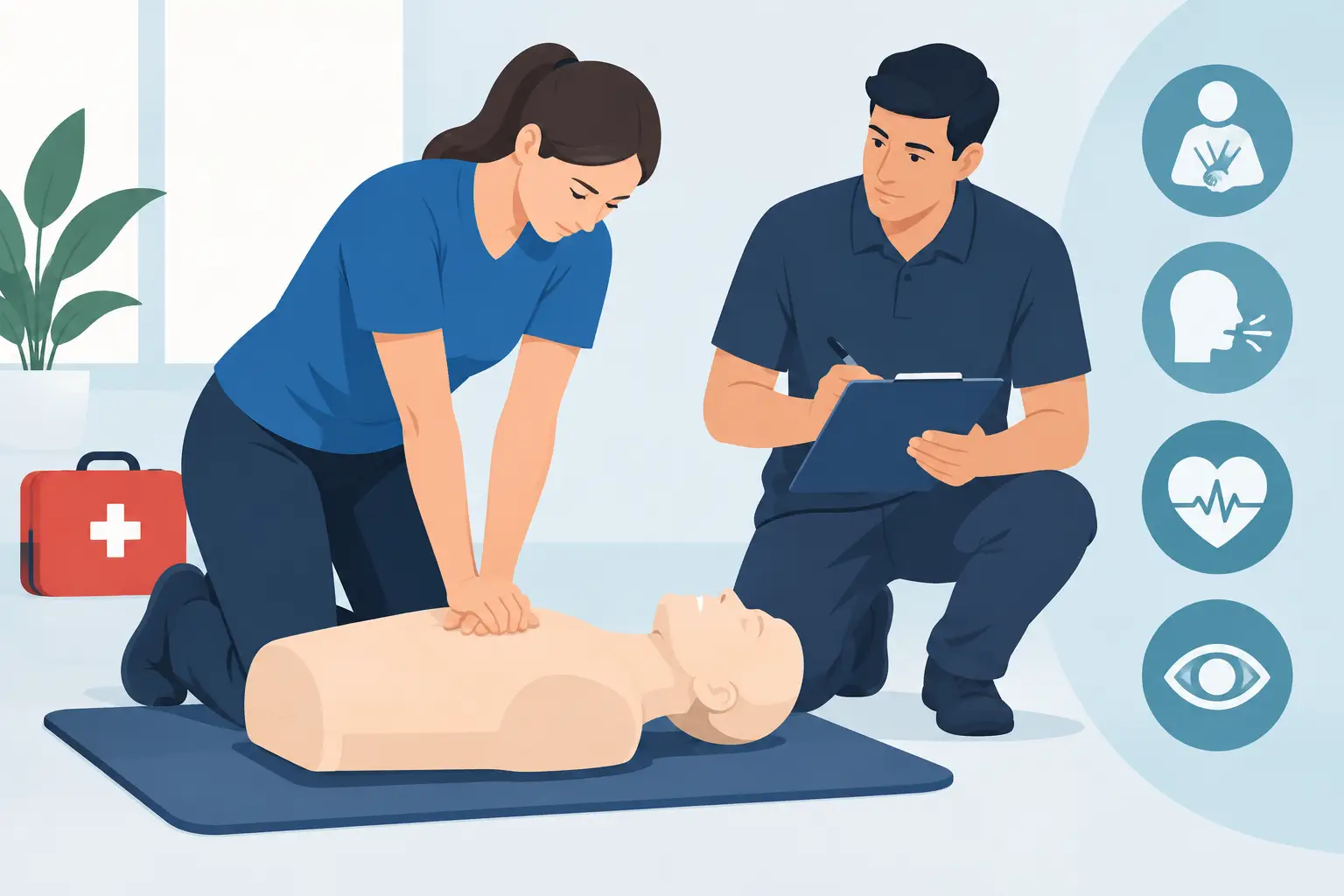
A CPR Level C assessment is not designed to catch you out. It is designed to confirm that you can recognize an emergency, follow the correct sequence, use equipment safely, and provide effective care without creating further risk. The fastest answer to how to pass CPR Level C is simple: attend prepared, follow the taught steps in order, and practice the physical skills until they feel controlled rather than rushed.
For Ontario workers, job seekers, supervisors, and security personnel, passing also has a practical outcome. You leave with a recognized credential that may be required by an employer or needed for workplace first aid compliance.
Know what CPR Level C covers
CPR Level C prepares you to respond to cardiac and breathing emergencies involving adults, children, and infants. It commonly includes one-rescuer and two-rescuer CPR, use of an automated external defibrillator (AED), choking response, recovery position, and care for an unresponsive person.
In a combined first aid and CPR course, you may also be assessed on scene management, emergency medical services activation, bleeding control, shock, and other first aid priorities. Your instructor will explain the course requirements at the start. Follow the procedures taught in that course, even if you have taken CPR elsewhere before. Standards and teaching sequences can be updated, and an assessment is based on the current course material.
The goal is not to memorize isolated facts. You need to show that you can make sound decisions under a realistic sequence: check the scene, assess the person, call for help, begin appropriate care, and continue until help takes over or the scenario changes.
How to pass CPR Level C before the in-person session
If your course uses blended learning, complete every assigned online module before attending practical training. Do not treat the online portion as a formality. It introduces the terminology, response priorities, and decision-making process that you will use in class. Learners who arrive without completing it often spend the day trying to catch up instead of practicing their skills.
Review the main emergency response sequence before class. You should be ready to check for hazards, use personal protective equipment when available, assess responsiveness, direct someone to call 911 and bring an AED, and check breathing according to the method taught by your instructor. Being familiar with the order lets you focus on calm delivery during hands-on practice.
Wear clothing that allows you to kneel, bend, and work on a floor manikin. CPR is physical. You may perform several rounds of compressions, practice moving into position, and work with a partner. Comfortable, professional clothing and closed-toe shoes reduce distractions.
Arrive on time. Missing the opening instruction can affect your understanding of assessment rules, attendance requirements, and course flow. Bring any required proof that your online work is complete and ask administrative questions before practical skill evaluation begins.
Perform the CPR sequence in the right order
During a skills assessment, instructors generally look for a complete response, not only chest compressions. Start with scene safety. You should make sure it is safe to approach, use barriers or gloves when appropriate, and identify yourself if the training scenario calls for it.
Next, check responsiveness and get help. In a witnessed collapse, clearly assign tasks when other people are available. For example, tell a specific person to call 911 and another to get the AED. Pointing to a person and giving a direct instruction is more effective than saying, “Someone call 911.”
Once the person is confirmed unresponsive and not breathing normally, begin CPR promptly. Place your hands correctly, position your body over the manikin, and deliver compressions at the depth and rate taught in class. Allow complete chest recoil between compressions. Instructors may use feedback manikins or observe your technique directly, so posture, hand placement, and consistency matter.
Deliver rescue breaths only as taught and only after creating an effective airway seal. Watch for visible chest rise. If a breath does not go in, reposition the head and try again according to the course procedure. Do not waste time repeatedly attempting breaths while ignoring the rest of the response sequence.
Use the AED confidently and safely
AED use is a core CPR Level C skill because early defibrillation can be critical during certain cardiac arrests. You do not need to be an equipment expert. You need to turn the unit on, follow its prompts, place pads correctly, and protect everyone during analysis and shock delivery.
State your actions clearly during practice. Make sure the chest is exposed and dry as required, apply the pads in the correct locations, and ensure nobody is touching the patient when the AED is analyzing. Before a shock, verbally and visually confirm that everyone is clear. Resume CPR immediately when the device directs you to do so.
Common errors include failing to clear the patient, waiting too long to restart compressions, or placing pads carelessly. Slow down enough to follow the prompts accurately, then return to CPR without unnecessary delay.
Do not neglect child and infant CPR
Adult CPR is often the most familiar part of the course, but Level C also requires you to adjust your approach for children and infants. The basic response framework remains similar, while hand placement, compression technique, and equipment choices change with the patient’s size.
For a child, use the method taught for appropriate compression depth and hand placement. For an infant, demonstrate careful positioning and the correct compression technique rather than treating the infant manikin like a smaller adult. Your instructor will explain when two-rescuer techniques apply and how roles should be coordinated.
The important point is to show that you recognize the patient category and adapt your care. Do not guess based only on height or appearance. Use the course definitions provided by your instructor.
Treat practice like the assessment
The practical portion of a CPR course is where most learners improve. Participate fully when the instructor demonstrates a skill, then repeat it until you can perform the sequence without coaching. Ask for correction early. It is better to adjust your hand placement during practice than to repeat an error during evaluation.
Work deliberately with your partner during two-rescuer scenarios. Communicate when changing compressors, avoid long pauses, and confirm who is handling the AED or emergency call. Good teamwork is part of effective emergency response, especially in workplaces where another trained person may be nearby.
If you feel uncertain, say so. A qualified instructor can clarify whether you are mixing up an old technique with the current course requirement, misunderstanding an AED prompt, or overlooking a step in the scene assessment.
Avoid the mistakes that lead to re-evaluation
Most learners do not struggle because they lack effort. They lose marks or need extra practice because they rush, skip a safety check, or focus on one action while forgetting the broader response. Keep your assessment organized from start to finish.
Avoid these four common problems:
- Starting care without checking that the scene is safe.
- Failing to call for emergency help or assign someone to bring an AED.
- Pausing CPR too long during breathing checks, AED use, or role changes.
- Using incorrect hand placement, compression technique, or patient-specific adjustments.
A written knowledge check may also be included, depending on the course provider and certification format. Read every question carefully. Look for the safest and most complete response, not the answer that sounds fastest. If a question concerns a situation you have not encountered, apply the principles taught in class: scene safety, early emergency activation, appropriate assessment, and timely care.
Plan for certification, not just the class day
Passing depends on attendance, active participation, successful completion of required online and in-person components, and meeting the instructor’s assessment standard. If you need certification for work, confirm the exact credential your employer requires before registering. Some roles require a full first aid course with CPR Level C and AED training rather than a standalone CPR course.
Canada First Aid offers Intermediate First Aid Level C with AED certification through a blended format that combines online learning with in-person skills instruction. For employees and job seekers, that structure gives you time to learn the knowledge portion before focusing on the practical skills that must be demonstrated face to face.
CPR is a performance skill, not a test you can pass by reading once. Show up prepared, listen to corrections, and treat each practice scenario as a real emergency response. That approach gives you the best chance of leaving class with both the credential you need and the confidence to act when someone needs help.