Employee Emergency Response Training at Work
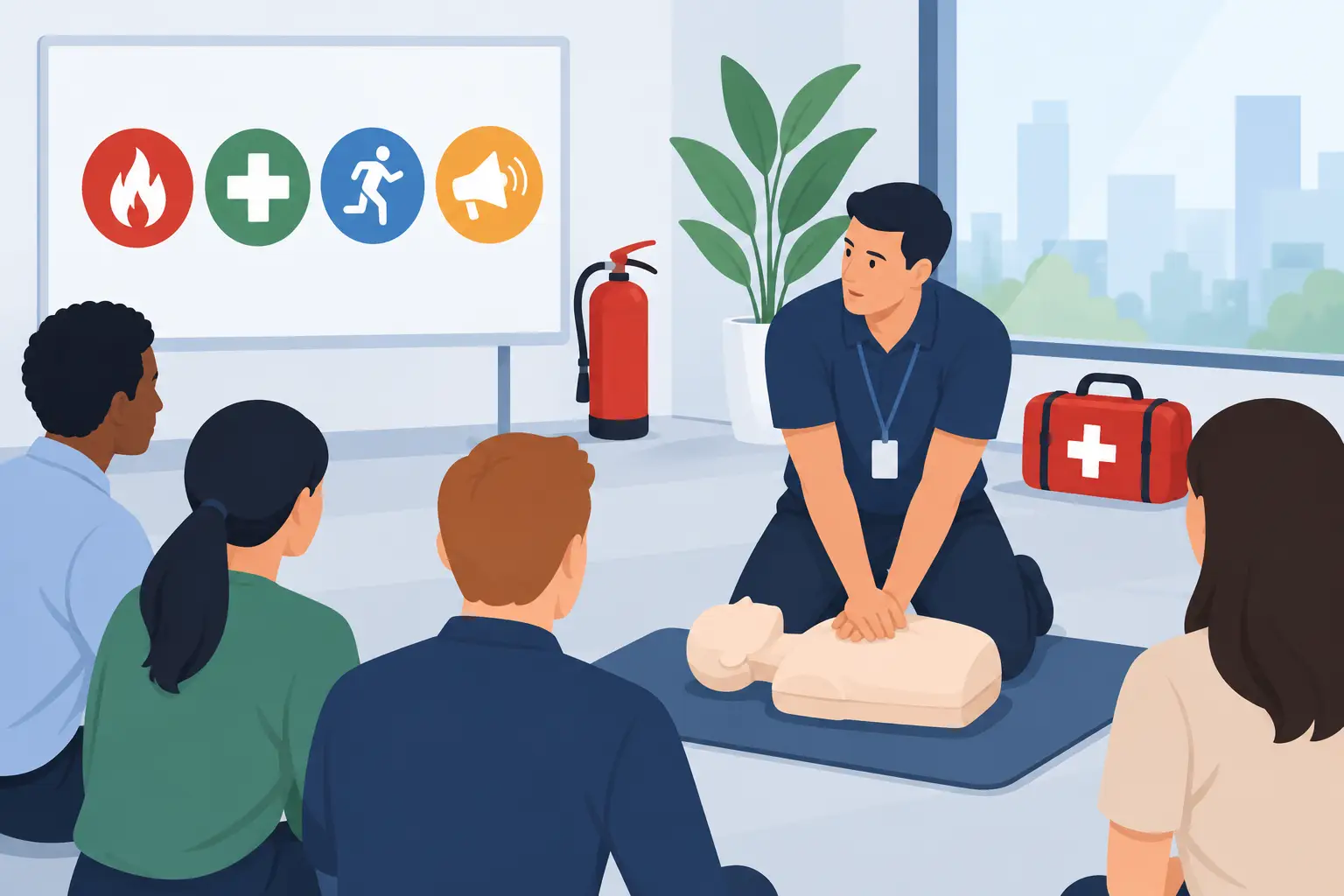
A medical emergency rarely waits for a supervisor, a first aid attendant, or an ambulance. A coworker may collapse in a break room, suffer a deep cut on a worksite, or show signs of a heart attack while the team is deciding what to do next. Employee emergency response training gives staff a clear, practiced way to respond in those first critical minutes.
For employers, the goal is not to turn every worker into a paramedic. It is to ensure people can recognize an emergency, protect themselves and others, call for appropriate help, and provide care within their training until emergency services take over. For employees, recognized certification can also meet job requirements and create confidence that is useful well beyond the workplace.
What Employee Emergency Response Training Should Cover
Effective training is practical. Employees need more than a presentation about safety policies or a checklist posted beside a first aid kit. They need to know what action is expected, what equipment is available, and how to use their skills under pressure.
A workplace-focused program should teach participants how to assess the scene before approaching, identify immediate hazards, obtain help, and communicate key facts to emergency responders. It should also cover the most common situations where prompt first aid can change an outcome: severe bleeding, choking, unconsciousness, breathing emergencies, shock, burns, fractures, seizures, allergic reactions, diabetic emergencies, and suspected heart attack or stroke.
CPR and automated external defibrillator, or AED, training are central components for many workplaces. Cardiac arrest requires immediate action, and an AED is designed to guide a trained responder through the process. Hands-on practice matters here. Reading the steps is not the same as placing pads correctly, following device prompts, or coordinating CPR with another responder.
The right scope depends on the work environment. An office may need strong coverage for medical emergencies, slips, falls, and cardiac events. A warehouse, construction site, security operation, or manufacturing facility may require greater attention to bleeding control, traumatic injuries, heat or cold exposure, and scene safety. Training should reflect the hazards employees are reasonably likely to encounter.
Training Is Part of a Wider Emergency Plan
First aid certification is essential, but it is only one part of emergency readiness. Employees also need to understand how their workplace response system operates. A capable responder cannot act efficiently if no one knows where the AED is stored, who contacts emergency services, or how responders enter a secured building.
Employers should connect emergency response instruction to their site procedures. This includes the location of first aid supplies, emergency exits, muster points, incident reporting processes, and the names or roles of designated first aid personnel. If a workplace has security staff, supervisors, or floor wardens with defined responsibilities, those responsibilities should be clear before an incident occurs.
A simple division of tasks helps during a real emergency. One person can stay with the injured worker, another can call 911, and another can meet emergency personnel at the entrance. In a small workplace, one individual may need to manage several tasks at once. That is why training should emphasize priorities: make the area safe, get help, provide care within your level of training, and document the incident according to workplace procedure.
Training also has limits. CPR and first aid courses do not replace emergency medical services, fire evacuation plans, hazardous-materials procedures, or specialized rescue training. Employees should never enter an unsafe area, handle an unknown chemical exposure, or attempt a technical rescue unless they have the equipment and specific training required for that work.
Choosing the Right Certification Level
Employers should begin with the actual workplace need, not the shortest available course. Provincial requirements, workplace hazards, employee count, shift coverage, and distance from emergency services can all affect the appropriate level of first aid training. Requirements may also differ across industries and change over time, so employers should confirm what applies to their site.
In Ontario, WSIB-recognized first aid training is commonly required for workplaces that fall under applicable provincial rules. A recognized course provides a clearer credentialing path than informal instruction and helps employers demonstrate that designated personnel received standardized training. It does not remove the employer's responsibility to maintain supplies, record incidents, and manage workplace hazards.
For many employees, Intermediate First Aid with CPR Level C and AED certification is a practical choice. It prepares participants to address a wide range of medical and injury-related emergencies while including adult, child, and infant CPR skills. This level can be particularly relevant for supervisors, security personnel, team leads, and workers assigned first aid duties.
Course delivery affects whether employees retain the material. Fully online instruction can be convenient for theory, policies, and decision-making concepts, but skills such as CPR, choking response, bandaging, and AED use require in-person practice and evaluation. A blended model can balance both needs by allowing learners to complete foundational content online before attending a focused, instructor-led practical session.
Canada First Aid offers a blended Intermediate First Aid Level C with AED course that combines eight hours of online coursework with eight hours of in-person instruction. For workers and employers in Ontario, this format can reduce time away from the job while preserving the practical assessment needed for a recognized certification outcome.
How Employers Can Make Training Work in Practice
Certification has value only when trained people are available when they are needed. A common mistake is certifying one employee on a single shift and assuming the workplace is covered. Vacations, sick days, turnover, remote work, and changing schedules can quickly leave a gap.
Start by identifying who is present during each shift, at each location, and in higher-risk work areas. Train enough employees to maintain coverage when designated responders are absent. Supervisors should know who holds current certification and when renewals are due, rather than discovering an expired credential after an incident or inspection.
Employers also need to make the physical resources usable. First aid kits should be accessible, stocked, and suited to the work being performed. AEDs should be clearly identified, maintained according to the manufacturer’s requirements, and included in orientation for new workers. If equipment is locked behind a desk, stored in an unfamiliar room, or missing critical supplies, trained employees lose valuable time.
Short refresher conversations can keep response procedures familiar between formal recertification courses. A supervisor might review the AED location during a safety meeting, confirm who calls 911, or walk a new team through the process for reporting an injury. These are not substitutes for certification, but they reinforce site-specific readiness.
Drills should be selected carefully. An evacuation drill is useful for fire response, while a tabletop discussion may be better for a medical emergency or severe-weather scenario. The purpose is not to create disruption for its own sake. It is to identify practical failures before they matter, such as an unclear meeting point, an outdated emergency contact list, or a locked entrance that delays responders.
What Employees Should Expect From a Quality Course
A quality emergency response course should be direct, hands-on, and assessed against clear standards. Participants should have time to ask questions, practice skills, receive corrections from an instructor, and demonstrate required techniques. They should leave knowing what they can do, when to call for help, and when not to take unnecessary risks.
Employees should also expect to practice communication. In an emergency, responders need concise information: the location, what happened, the person's condition, hazards at the scene, and care already provided. This information helps dispatchers and emergency crews prepare before they arrive.
The most useful training does not promise that emergencies will feel easy. They are often stressful, confusing, and fast-moving. Good instruction gives people a sequence to follow when adrenaline is high: assess safety, get help, provide appropriate care, and continue until responsibility is transferred.
A current certificate is a valuable employment credential, but its greater value is operational. When an emergency happens, trained employees can replace uncertainty with immediate, organized action. That is the standard a workplace should prepare for.