Does First Aid Include CPR? Know What Your Course Covers
A job posting says “first aid and CPR required,” while a course listing simply says “first aid.” Does first aid include CPR in that situation? Sometimes it does, but you should never assume it does. First aid and CPR are closely connected emergency-response skills, yet they can be taught, certified, and renewed as separate components.
For Ontario workers, job seekers, supervisors, and employers, the distinction matters. The wrong course may leave you without the credential your employer requested. The right course gives you both practical response skills and documentation that supports workplace safety requirements.
Does First Aid Include CPR?
First aid courses often include CPR, but the level of CPR depends on the specific course. A recognized workplace first aid program may bundle first aid, CPR, and automated external defibrillator (AED) training under one certificate. Other programs may provide basic first aid with a lower CPR level, while a standalone CPR course may not include the broader first aid content required for a workplace role.
Read the course title and certificate description, not just the word “first aid.” Look for clear wording such as CPR/AED, CPR Level C, or Intermediate First Aid with CPR/AED. If an employer specifies a particular level, match that requirement exactly before registering.
The practical reason is simple: first aid covers a wide range of sudden illnesses and injuries. CPR focuses on responding to cardiac arrest and other life-threatening breathing emergencies. Both skills are valuable, but they are not interchangeable.
What First Aid Training Usually Covers
First aid teaches you how to assess a scene, protect yourself and others, get emergency help, and provide care until professional responders take over. Course content varies by certification level and training standard, but workplace-oriented programs commonly address bleeding, shock, choking, burns, fractures, seizures, diabetic emergencies, allergic reactions, poisoning, and sudden medical conditions.
A strong course does more than explain what to do. It requires hands-on practice. You need to work through scenarios, use first aid equipment correctly, communicate with emergency services, and make decisions under time pressure. Online theory can establish the knowledge base, but in-person instruction is where instructors can assess skill performance.
First aid also includes judgment. Not every situation calls for the same response, and a trained responder must recognize when an injury can be monitored, when it requires medical assessment, and when immediate emergency action is necessary. That is why a first aid credential should identify the actual standard completed rather than rely on a general label.
CPR Is a Specific Emergency Skill Set
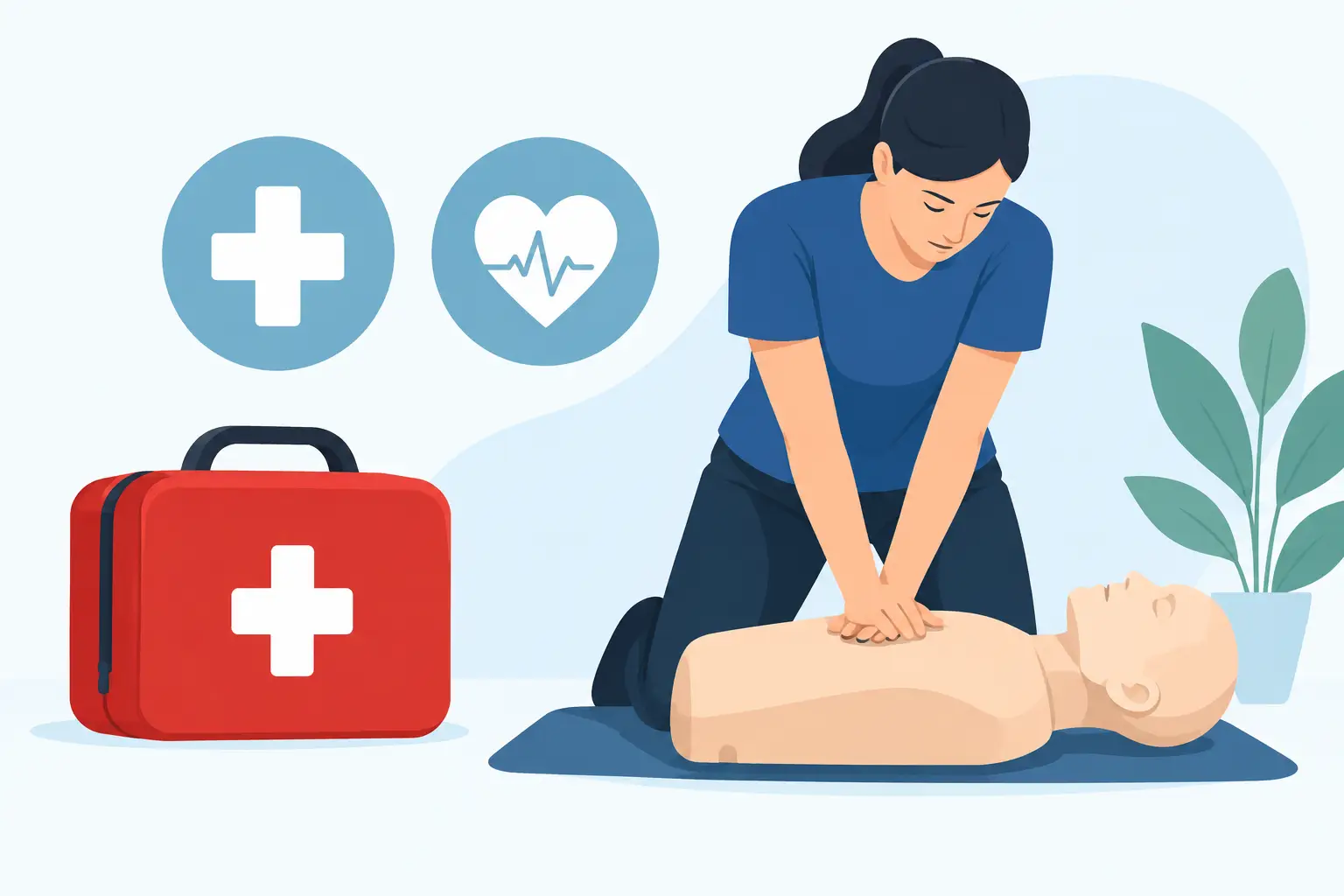
CPR, or cardiopulmonary resuscitation, is used when a person is unresponsive and not breathing normally. It involves recognizing cardiac arrest, calling for emergency help, delivering chest compressions, providing rescue breaths when trained and appropriate, and using an AED as soon as one is available.
CPR training also covers choking response and may include differences in care for adults, children, and infants. The exact scope depends on the level of certification. A course that teaches adult-only CPR may be sufficient for some settings, while workplaces, security roles, child-facing positions, and many public-facing jobs may require CPR Level C because it addresses all age groups.
AED training is usually taught alongside CPR because early defibrillation can be critical in cardiac arrest. An AED is designed to guide a responder through the process with voice and visual prompts, but training helps people act quickly, place pads correctly, and reduce hesitation during a high-stress event.
Common Course Combinations and What They Mean
Course names differ among providers, so confirm the curriculum and certificate before you enroll. In general, the following combinations are common.
CPR/AED-only training concentrates on cardiac arrest, choking, CPR techniques, and AED use. It is useful when a role requires CPR but not a full first aid credential.
Emergency first aid with CPR/AED is generally a shorter program that combines basic first aid response with CPR and AED skills. It may meet the needs of lower-risk workplaces or individuals who want an entry-level certificate, depending on the employer’s requirements.
Standard or Intermediate First Aid with CPR/AED offers more extensive first aid content and practical training. This is frequently the appropriate option where an employer requires a comprehensive workplace first aid certificate.
CPR Level C with AED usually indicates CPR and AED training for adults, children, and infants. It may be included within a first aid course or issued as its own CPR-focused certification.
The label alone still is not enough. Ask whether the program includes in-person skills assessment, whether it issues a recognized certificate, and whether its duration and content meet your workplace requirement. Employers may use older course names, so confirm the accepted equivalent if the job posting is unclear.
Why the Difference Matters for Workplace Requirements
An employer may require first aid and CPR because the workplace needs a designated responder able to manage more than cardiac emergencies. A worker might need to control severe bleeding, assist a person having a seizure, respond to a burn, or stabilize an injured person while emergency services are on the way. CPR is essential when cardiac arrest occurs, but it is only one part of that responsibility.
At the same time, some roles specifically prioritize CPR. A security professional, fitness worker, camp staff member, or employee working around children may be asked for CPR Level C with AED certification because they are likely to interact with people of different ages. Healthcare-adjacent workplaces may have separate or additional requirements.
For Ontario workplaces, training needs can depend on the work environment, number of workers, hazards present, and employer policies. WSIB-recognized training is often a key consideration for workplace compliance. Employees should not guess, and employers should avoid sending staff to a course that is shorter or narrower than the required standard.
How to Choose the Right First Aid and CPR Course
Start with the exact wording from your employer, job posting, licensing body, or school placement coordinator. If it says “Intermediate First Aid Level C with AED,” choose a course that states that combination on the certificate. If it says “first aid and CPR,” ask the employer whether an Emergency First Aid or Intermediate First Aid credential is required, and confirm the needed CPR level.
Next, consider how the course is delivered. Blended learning can be a practical choice for busy workers because it divides instruction between online coursework and in-person skills training. The online component allows you to complete theory on a schedule that works for you. The in-person session verifies practical skills, including CPR quality, AED operation, bandaging, patient assessment, and emergency scenarios.
This format is efficient, but it requires planning. Complete the online section before your practical session, allow enough time for both parts, and confirm the attendance and evaluation requirements. A certificate cannot be issued simply because a learner watched modules or attended part of a class.
Canada First Aid offers Intermediate First Aid Level C with AED certification through an 8-hour online and 8-hour in-person blended format for learners who need a recognized, workplace-ready credential. For people in Toronto and Peel, that structure can reduce time away from work while maintaining hands-on assessment.
Questions to Ask Before You Register
Before paying for a course, confirm four points: the full certificate name, the CPR level included, whether AED training is included, and whether the credential is accepted by your employer or regulator. Also check the course length, practical attendance requirements, certificate validity period, renewal options, location, and total price.
If you need certification by a certain start date, ask when certificates are issued and whether you must successfully complete all evaluations before receiving proof of completion. Do not wait until the day before a job begins to find out that your course does not include the required CPR level.
Certification Is Not the Same as Confidence
A valid card matters for compliance, but the purpose of training is to prepare you to act. The person who collapses at work will not care whether the certificate title was convenient or inexpensive. They need someone who can recognize abnormal breathing, call 911, start effective compressions, send another person for an AED, and continue until responders arrive.
That is why course quality and practical instruction matter. Skills can fade without use, especially CPR. Refresh your knowledge between recertification dates, know where AEDs and first aid kits are located at work, and raise concerns if supplies are missing or inaccessible.
Choose the certificate your role requires, then treat the training as a workplace responsibility rather than a box to check. The right first aid and CPR course gives you a recognized credential, but more importantly, it gives you a clear next action when someone needs help.