How to Operate a Public AED in an Emergency
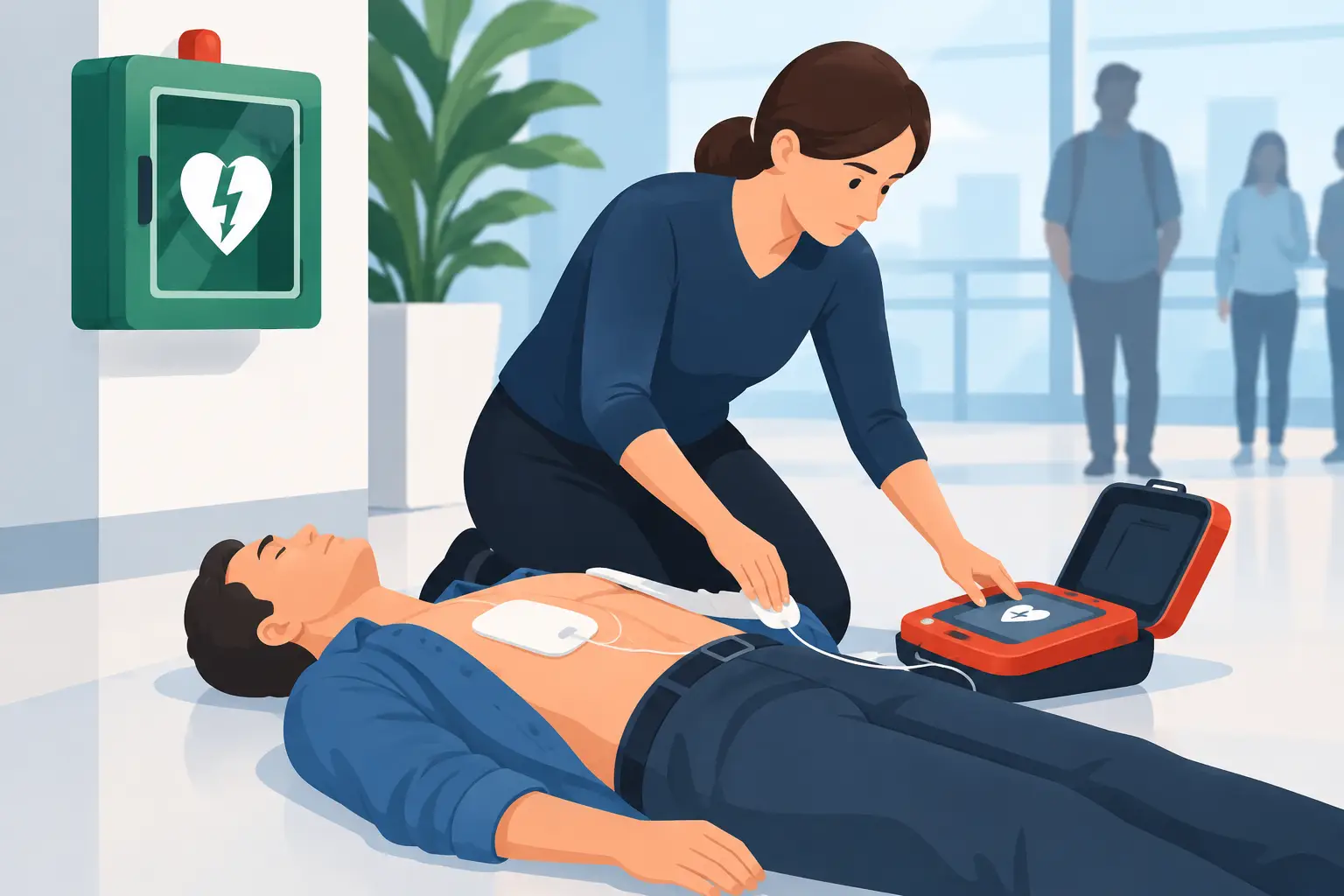
A public AED may be mounted in a mall hallway, office lobby, gym, transit station, or community center. When someone suddenly collapses, the device is designed for use by bystanders, not only medical professionals. Knowing how to operate a public AED can help you act quickly while emergency services are on the way.
How to Operate a Public AED: Start With the Scene
Before touching the person, check that the area is safe. Look for traffic, electrical hazards, spilled liquids, violence, or anything else that could put you or others at risk. You cannot provide effective care if you become injured yourself.
Approach the person and check for responsiveness. Speak loudly, tap their shoulders, and ask if they are okay. If there is no response, check whether they are breathing normally. Occasional gasps, irregular snoring sounds, or no breathing should be treated as a life-threatening emergency.
Call 911 immediately, or clearly direct a specific person to call. If other people are nearby, give direct instructions: “You call 911. You get the AED. Come back right away.” This prevents the common problem where everyone assumes someone else has called for help.
If you are alone with an adult, call 911 on speakerphone if possible, then retrieve the nearest AED if it is close by. Return to the person without unnecessary delay.
Begin CPR While the AED Is Retrieved
For an unresponsive person who is not breathing normally, start CPR immediately. Place the heel of one hand in the center of the chest, place your other hand on top, and keep your arms straight. Press hard and fast at a rate of 100 to 120 compressions per minute, allowing the chest to fully rise between compressions.
If you are trained and willing to provide rescue breaths, give 30 compressions followed by 2 breaths. If you are not trained, cannot safely give breaths, or are uncomfortable doing so, hands-only CPR is appropriate for a witnessed adult collapse. Continuous chest compressions are far better than waiting for professional responders.
The AED should be brought to the person as soon as possible. One person can continue CPR while another opens and prepares the device.
Turn On the AED and Follow Its Prompts
Public AEDs are designed to give spoken instructions. Open the case, turn on the device, or lift the lid, depending on the model. Most units begin giving voice prompts immediately. Follow those prompts in order. Do not spend time trying to identify the model or read every instruction printed on the unit.
Expose the person’s bare chest. Cut or remove clothing as needed. If the chest is wet, quickly dry it so the pads can adhere properly. If the person has excessive chest hair and the pads will not stick, use the razor included in many AED kits to remove hair only where the pads will be placed. Do not delay pad placement for minor hair.
Remove the adhesive pads from their backing and place them exactly as shown in the diagram. For most adults, place one pad on the upper right side of the chest, below the collarbone. Place the other pad on the lower left side of the chest, below the armpit.
The pad diagrams are the primary reference. Some AEDs use different pad layouts, and pediatric pads may have a different placement guide.
Special placement issues
If the person has a visible implanted pacemaker or defibrillator, you may see or feel a small raised device under the skin, often near the upper chest. Do not place an AED pad directly over it. Position the pad at least one inch away.
If you see a medication patch where a pad should go, remove the patch using gloves or another barrier if available, wipe the area, and apply the pad. Jewelry, such as a necklace, usually does not need to be removed unless it interferes with pad placement.
For children, use pediatric pads or a pediatric mode when available and when the device instructions call for it. If pediatric pads are unavailable, use adult pads according to the AED instructions. In a small child, pads may need to be placed on the front and back of the chest so they do not touch.
Keep Everyone Clear During Analysis
Once the pads are attached, the AED will analyze the person’s heart rhythm. At this point, no one should touch the person. Say clearly, “Stand clear,” and visually check that everyone has moved away.
Touching the person during analysis can interfere with the AED’s reading. Stop CPR only when the device tells you to analyze. If the AED says that no shock is advised, begin CPR again immediately. A no-shock message does not mean the person is safe or that care is no longer needed.
If the AED advises a shock, make sure nobody is touching the person, including anyone holding a hand, supporting the head, or leaning against the person. State “Clear” loudly, check the area again, and press the shock button if the device instructs you to do so. Some newer AEDs deliver the shock automatically after warning everyone to stand clear.
Resume CPR Immediately After a Shock
After a shock is delivered, do not pause to look for movement, a pulse, or normal breathing unless the AED specifically tells you to do so. Resume CPR right away, starting with chest compressions. The AED will usually reanalyze after about two minutes and provide the next instruction.
Continue the cycle of CPR, AED analysis, and shocks when advised until one of three things happens: the person shows clear signs of life, EMS personnel take over, or you are physically unable to continue. If the person begins breathing normally but remains unresponsive, leave the pads attached, place them on their side if safe to do so, and monitor them closely. The AED may be needed again.
Do not turn off or remove the AED once it is attached unless emergency responders direct you to do so. Leave the device, pads, and any packaging in place for EMS. Responders may need the AED’s event data as part of their assessment.
What Public AED Users Commonly Get Wrong
The most damaging delay is waiting for certainty. You do not need to diagnose a heart attack or prove that cardiac arrest has occurred before using an AED. If a person is unresponsive and not breathing normally, call 911, begin CPR, and apply the AED.
Another mistake is treating the device as complicated equipment. Public AEDs are intentionally built for use under stress. The voice prompts guide the process, and the machine decides whether a shock is appropriate. Your job is to apply the pads correctly, keep everyone clear during analysis and shock delivery, and restart CPR as directed.
Do not worry that you will shock someone unnecessarily. An AED analyzes the heart rhythm before advising a shock. It will not recommend a shock when it does not detect a shockable rhythm.
Training Makes the Response Faster
An AED can guide an untrained bystander, but formal first aid and CPR training gives you a practical advantage. Training helps you recognize abnormal breathing, deliver effective compressions, manage a crowded scene, communicate with 911, and use AED equipment without hesitation.
For employees, supervisors, security personnel, and workplace teams, recognized CPR and AED training also supports a more organized emergency response. The device is only one part of the response. Fast activation of EMS, quality CPR, clear communication, and competent handoff all matter.
When you see a public AED, take a moment to notice its location. In a real emergency, familiarity with the nearest device can save the seconds that make action possible.