Virtual Versus Hands-On CPR: What Counts?
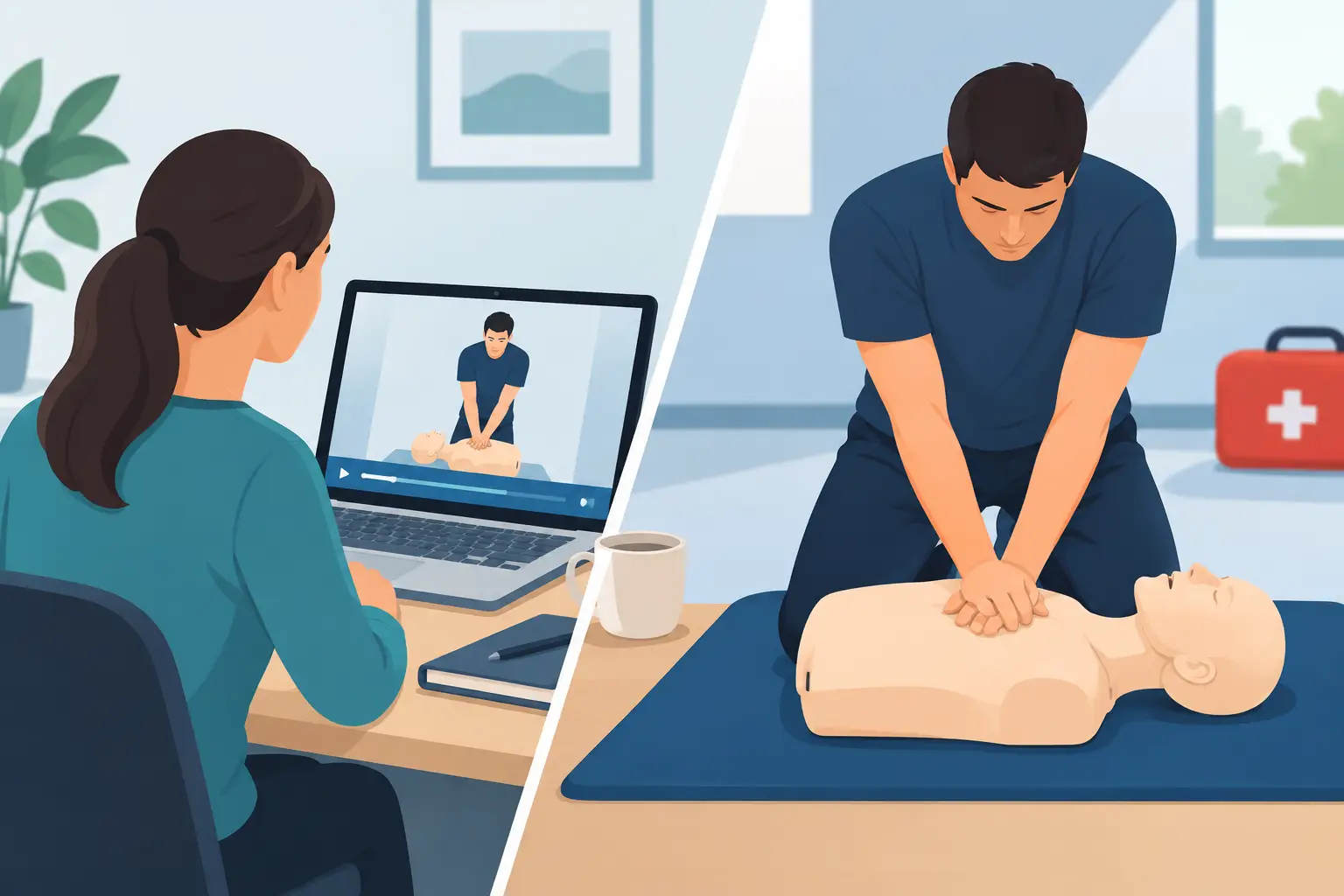
A CPR certificate can be required before a first shift, a security assignment, or a workplace audit. That makes the choice between virtual versus hands-on CPR more than a scheduling question. The format affects what you learn, what you can demonstrate, and whether the credential meets an employer’s or regulator’s requirements.
Virtual learning can cover essential CPR knowledge efficiently. Hands-on instruction is where that knowledge is tested under realistic conditions. For most recognized workplace first aid certifications, learners need both.
Virtual Versus Hands-On CPR: The Core Difference
Virtual CPR training focuses on the decision-making behind an emergency response. It can teach learners how to recognize cardiac arrest, call for emergency help, assess scene safety, follow the chain of survival, and understand the basic sequence of CPR and AED use. Online modules also allow learners to work through course material at a controlled pace and review sections when needed.
That flexibility is valuable, particularly for employees balancing shift work, job seekers preparing for a role, and employers coordinating training for several staff members. Online coursework can reduce the amount of classroom time required without removing the instructional content learners need before practical training.
Hands-on CPR training has a different purpose. Learners practice compressions on a manikin, use training AED equipment, work through choking scenarios, and respond to instructor feedback. They must show that they can perform the required skills, not simply identify the correct answer on a screen.
CPR is a physical skill. Compression depth, rate, hand placement, body position, and minimizing interruptions all matter. A video can explain these requirements, but it cannot confirm whether a learner is performing them correctly. That confirmation requires an instructor, appropriate equipment, and a practical skills evaluation.
Why Hands-On Practice Still Matters
During an actual cardiac emergency, people do not respond from a multiple-choice menu. They need to assess the situation, call 911, begin care, communicate with bystanders, and use an AED when it becomes available. Stress can make even familiar steps harder to recall.
Practical instruction creates a controlled setting for that pressure. Learners can make errors, correct them immediately, and repeat the skill until the sequence becomes more reliable. An instructor may identify shallow compressions, incorrect hand placement, delayed AED pad placement, or hesitation during a scenario. Those details are difficult to evaluate through self-directed virtual learning alone.
Hands-on practice also helps learners understand the physical demands of CPR. Effective chest compressions require sustained effort. Practicing on a manikin gives participants a realistic sense of pace and fatigue while reinforcing the need to switch rescuers when another trained person is available.
For workplace teams, practical sessions offer another benefit: coordinated response. Staff can practice assigning tasks, retrieving the AED, directing emergency services to the scene, and supporting a person who is providing care. This is especially useful for supervisors, security personnel, and designated first aid attendants who may be expected to take early control of an emergency.
What Virtual Training Does Well
Virtual training should not be dismissed as less valuable simply because it is not the final skills assessment. It can be an efficient and effective part of a properly structured program.
Online coursework is well suited to content that requires reading, video instruction, knowledge checks, and scenario-based decisions. This includes emergency scene management, legal considerations, infection prevention, the signs of heart attack and stroke, and the steps involved in responding to breathing emergencies. It gives learners time to absorb the material before being asked to perform it.
A blended format can also improve the quality of in-person class time. When learners arrive with a working understanding of the procedures, instructors can focus on coaching, scenarios, corrections, and skill verification rather than spending the entire session delivering introductory theory.
The limitation is clear: completing online modules does not automatically prove CPR competency. If a course is presented as fully virtual, participants should confirm whether it includes a recognized in-person skills session and whether the final certificate meets their specific employment or regulatory requirement.
When Is a Virtual CPR Certificate Acceptable?
The answer depends on who requires the certificate and what standard applies. Some organizations may accept online awareness training for internal education, refresher information, or general preparedness. That may be appropriate when no formal practical credential is needed.
Employment requirements are often different. A job posting, workplace policy, licensing body, insurer, or safety program may specify a recognized first aid and CPR certificate. In those cases, a virtual-only course may not meet the requirement, particularly if no instructor observed and evaluated practical skills.
Before enrolling, ask three direct questions: What certification will be issued? Does the course include an in-person practical evaluation? Is the certificate accepted by my employer, workplace, or governing body?
Do not assume that a completion record, downloadable document, or online quiz result is equivalent to a recognized certification. The course provider should state the credential clearly, including the training standard, CPR level, AED component, validity period, and practical attendance requirement.
Blended Training Is Often the Practical Choice
Blended first aid and CPR training combines online theory with instructor-led practical instruction. It is designed for learners who need a recognized credential but also need a schedule that works around employment, commuting, and other responsibilities.
For example, Canada First Aid delivers Intermediate First Aid Level C with AED certification through eight hours of online coursework and eight hours of in-person training. The online component covers foundational knowledge before class. The in-person component is used for practical first aid scenarios, CPR performance, AED use, and instructor assessment.
This structure is not a shortcut. It is a division of training time based on what can be learned independently and what must be demonstrated in person. Learners still complete the practical portion, and instructors can verify that required skills are performed to the course standard.
For Ontario workplaces, this distinction is particularly relevant when training must support WSIB-recognized first aid requirements. Employers should verify the course level their workplace needs and ensure employees complete all required online and in-person portions before treating the credential as valid.
Choosing the Right Format for Your Situation
A virtual-only course may be useful if your goal is personal awareness and no employer or organization requires a formal skills-based certificate. It can introduce CPR procedures, improve emergency readiness, and help a learner understand what to expect in a later practical course.
Hands-on or blended training is the better fit when you need certification for work, want instructor feedback, or expect to use the skills in a professional setting. It is also the stronger choice for people who have never practiced CPR before. Reading the steps is not the same as kneeling beside a manikin, delivering compressions, applying AED pads, and receiving real-time correction.
Employers should avoid choosing a format based only on the lowest price or shortest advertised duration. A course that does not meet the required standard can create unnecessary retraining costs and leave workers without the credential they were hired to obtain. Confirm the provider’s recognition status, course structure, certificate details, and practical attendance policy before registering staff.
How to Prepare for the In-Person Session
The most efficient learners treat the online portion as preparation, not a box to check. Complete each module carefully, take notes on the emergency response sequence, and make a list of any procedures that are unclear. This allows you to use class time for practice rather than basic clarification.
Wear comfortable clothing for the practical session. CPR practice involves kneeling, leaning over a manikin, and participating in first aid scenarios. Arrive on time, bring any required identification or completion record for the online portion, and be prepared to participate fully.
If you have a physical limitation that could affect practical participation, contact the provider before class. Training staff can explain the course requirements and discuss what accommodation may be available. Do not wait until the final evaluation to raise a concern that could affect completion.
The best CPR course is not simply the one that fits into a calendar. It is the one that gives you a credential your workplace recognizes and the practical confidence to act when someone’s life may depend on the next few minutes.