Online Modules Versus Classroom First Aid
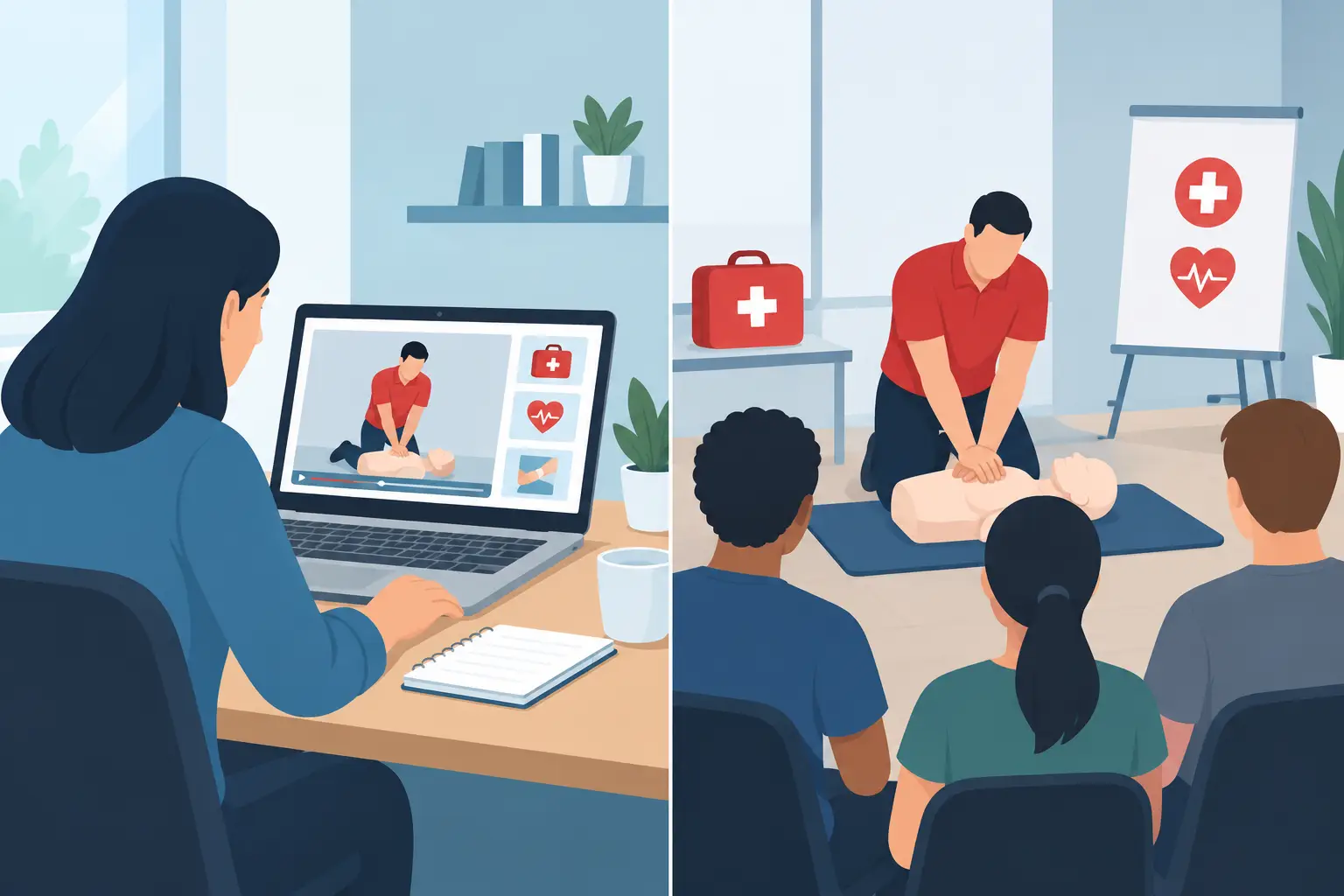
A first aid credential is not simply proof that someone completed a lesson. For most employees, job seekers, supervisors, and security personnel, it must also show that the training meets an employer's requirements and that the learner can respond under pressure. That is why the decision between online modules versus classroom first aid deserves more attention than choosing the fastest available course.
Online learning can make training easier to schedule. Classroom instruction develops the physical skills that cannot be fully assessed through a screen. For learners who need a recognized workplace credential, a blended format often provides the most practical balance: complete the knowledge-based work online, then attend an in-person session for instruction, practice, and evaluation.
What Online First Aid Modules Do Well
Online modules are effective for material that requires reading, recall, and scenario-based decision-making. Learners can work through legal responsibilities, emergency scene safety, infection prevention, shock, medical emergencies, and the early steps of an emergency response at a controlled pace.
This format is particularly useful for busy adults. Instead of losing an entire workday to lecture-based instruction, participants can complete assigned coursework around shifts, family obligations, or commuting time. They can pause, review a section, and repeat knowledge checks before moving forward.
For employers, online coursework can also reduce scheduling pressure. A group does not need to be in the same room for every theory component. Employees arrive at the practical session with a shared foundation, allowing the instructor to use class time for the skills that require direct supervision.
Online modules are not a replacement for hands-on first aid practice, however. Watching a CPR demonstration is different from positioning your hands correctly, maintaining compressions at the required depth and rate, using an AED trainer, or managing equipment while another person gives instructions. A course can explain these actions online, but it cannot reliably evaluate them without an instructor present.
Where Classroom First Aid Remains Essential
Classroom training provides the practical assessment that employers and recognized certification systems expect. In-person instruction gives learners immediate correction. An instructor can identify shallow chest compressions, incorrect hand placement, poor body positioning, delayed scene checks, or uncertainty during a simulated emergency.
This feedback matters because first aid is a performance skill. A learner may understand the CPR sequence in a quiz and still struggle to complete the sequence smoothly when kneeling beside a manikin, managing barriers, or responding to a changing scenario.
Classroom sessions also create realistic practice opportunities. Participants work with CPR manikins, AED training units, bandages, and other training equipment. They practice communication, role assignment, and decision-making with other people in the room. These are the conditions that make a workplace response more organized when a real incident occurs.
For Level C CPR, practical training is especially valuable because the course addresses adult, child, and infant CPR skills. Learners need time to apply the appropriate technique to each age group rather than relying on a written description. The same principle applies to AED use: the device provides prompts, but a responder must still act safely, confidently, and without unnecessary delay.
Online Modules Versus Classroom First Aid: The Compliance Question
The main question is not which format is more convenient. It is whether the course meets the certification standard required for the learner's role.
A fully online course may be useful for general awareness or refresher knowledge. It may also suit someone who wants basic information for personal preparedness without needing a formal workplace certificate. But employers, job postings, and workplace safety programs often require recognized training that includes an in-person skills component and evaluation.
Before registering, learners should confirm four points with the employer or hiring manager: the required certification level, whether CPR Level C is needed, whether AED training is included, and whether the provider's certificate is accepted for the role. This is more efficient than completing a low-cost online course and discovering later that it does not satisfy the requirement.
Ontario workplaces may have specific obligations based on the nature of the work, the size of the workplace, and the level of risk. Employers should select training that supports their workplace first aid program and aligns with applicable requirements. A recognized course with documented practical instruction offers stronger evidence that employees have received more than theory-only training.
Why Blended Learning Is Often the Practical Choice
Blended first aid training separates the course into two parts: online theory and instructor-led practical learning. The format respects the value of both methods without asking learners to choose convenience over skill development.
Canada First Aid delivers Intermediate First Aid Level C with AED certification through an 8-hour online component and an 8-hour in-person component. Learners can complete the knowledge portion before attending the classroom session, then focus their in-person time on practice, scenarios, and evaluated skills.
This structure is useful for people who need a clear credentialing outcome. The online portion covers the course content in an organized format. The classroom portion confirms that the participant can perform the required techniques. Together, they support WSIB-recognized training requirements while reducing the amount of lecture time in the classroom.
Blended training is not necessarily the best choice for every situation. Someone seeking informal awareness training may prefer a short online module. A person who learns best through direct discussion may prefer a fully classroom-based course if available. However, for workplace certification, a blended course is often the stronger option because it combines flexibility with direct skills assessment.
How to Choose the Right Format for Your Situation
Start with the purpose of the training. If a job application, employer, contract, or workplace policy requires certification, choose the course level and provider based on that requirement first. Do not assume that every certificate labeled "first aid" carries the same recognition or includes the same practical content.
Next, consider the learner's schedule. Online modules can reduce time away from work or simplify training for employees on different shifts. Still, the in-person session should be scheduled promptly after the online portion so that the theory remains fresh when participants begin practical exercises.
Then consider the role. Security guards, supervisors, designated workplace first aid attendants, child-care workers, and employees in public-facing environments may benefit from the confidence built through hands-on scenarios. These roles can involve incidents where a calm, practiced response matters as much as knowing the correct sequence of steps.
Finally, look beyond course duration. A shorter program is not automatically a better value if it does not meet the employer's requirement. The right course should state the certification level, CPR component, AED coverage, delivery format, practical evaluation, and any recognition relevant to workplace use.
What Learners Should Expect From the In-Person Session
The classroom portion should not feel like an administrative formality. It is where learners apply course knowledge under instructor guidance and demonstrate the skills required for certification.
Participants should expect to practice assessing the scene, checking responsiveness, activating emergency services, providing CPR, using an AED trainer, and responding to common first aid situations. Depending on the course, instruction may also cover severe bleeding, choking, fractures, burns, medical emergencies, and other situations that require timely action.
A good practical session allows for questions and repetition. Learners do not need prior medical experience, but they should be prepared to participate actively. Comfortable clothing is sensible because CPR practice and recovery-position work require kneeling, bending, and moving around the training area.
The most useful first aid course is the one that meets the required standard and leaves the learner ready to act. Choose a format that gives you both a recognized credential and enough supervised practice to use it when someone needs help.