Security Guard First Aid Outcomes That Matter
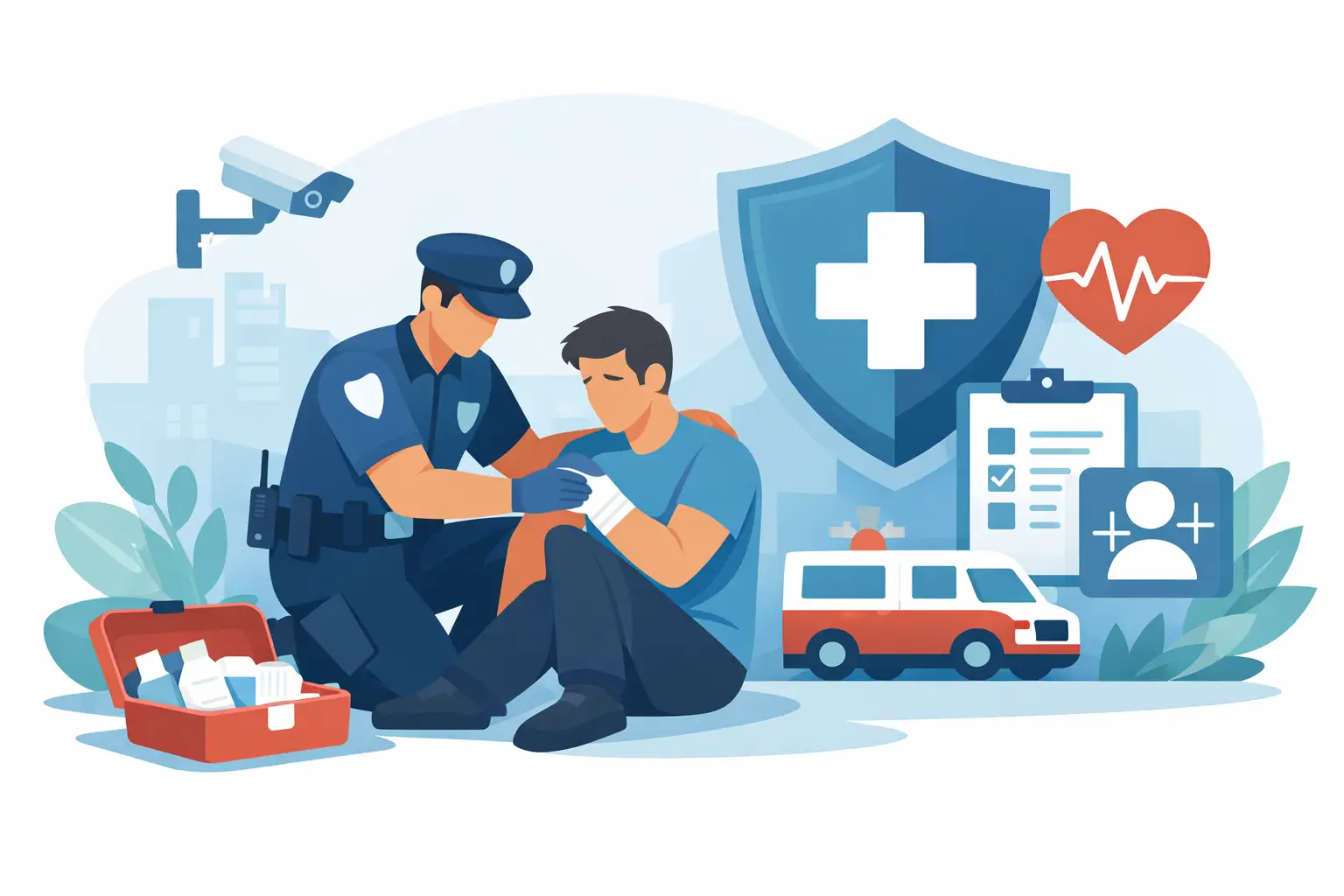
A security guard is often the first trained person on scene when a visitor collapses, a worker is injured, or an altercation results in trauma. Security guard first aid outcomes are not measured by whether someone attended a class. They are measured by whether the guard can recognize an emergency, protect the scene, call for help, and provide appropriate care until EMS takes over.
For employers, property managers, and guards themselves, this distinction matters. A current certificate may satisfy a job posting or site requirement, but effective training must also support calm, defensible action under pressure. The right course builds both the credential and the practical response skills needed for real security work.
What Security Guard First Aid Outcomes Should Include
A capable response begins before treatment. Guards must assess whether the environment is safe, identify immediate hazards, and avoid becoming another casualty. On a busy site, that can mean controlling access around a medical emergency, separating bystanders from a violent incident, directing staff away from a spill, or identifying an exposed electrical hazard.
The next outcome is early recognition. A guard should be able to identify when a person is unresponsive, not breathing normally, bleeding severely, choking, showing signs of overdose, or experiencing possible stroke, heart attack, seizure, or diabetic emergency. The goal is not diagnosis. It is recognizing warning signs quickly enough to activate emergency services and begin the appropriate first aid steps.
Effective training also produces clear communication. Security personnel regularly become the link between the public, site management, dispatch, and responding paramedics. A guard needs to provide a concise account of what happened, where it occurred, the person’s condition, care already given, and any continuing risks at the scene. Clear information helps EMS arrive prepared and helps the employer document the incident accurately afterward.
Finally, guards need the confidence to act within their training. First aid is not a substitute for professional medical care or law enforcement intervention. A disciplined responder gives care that is appropriate to the situation, avoids unsafe actions, respects privacy where possible, and transfers responsibility properly when emergency personnel arrive.
Why First Aid Outcomes Matter in Security Work
Security assignments put guards near higher-risk situations more often than many office-based roles. A guard may work alone at night, monitor a large building, patrol parking areas, manage access at a construction site, or respond to disturbances in a retail, residential, healthcare, or event setting. The setting changes, but the basic responsibility remains: stabilize the immediate situation and get qualified help moving.
A strong first aid response can improve outcomes in time-sensitive emergencies. Early CPR and AED use may be critical when someone is in cardiac arrest. Direct pressure and proper bleeding control can reduce blood loss before paramedics arrive. Quick recognition of stroke symptoms can speed up emergency activation and protect the person from delays caused by uncertainty or poor communication.
There is also an operational outcome. When a guard knows how to handle an emergency, the site is less likely to fall into confusion. One team member can call 911, another can retrieve an AED or first aid kit, and the guard can manage the immediate scene. This supports public safety while allowing supervisors and emergency responders to work from reliable information.
Training does not guarantee that every emergency will have a positive medical result. The severity of the illness or injury, response times, available equipment, and the person’s condition all matter. What training can do is reduce avoidable delays and prepare the guard to make sound decisions during the minutes that matter most.
Certification Must Match the Assignment
Not every security position has the same first aid requirement. An employer, client contract, job posting, collective agreement, or internal policy may specify the level of certification required. In Ontario, guards and employers should confirm what their particular assignment requires rather than assuming that any basic course will be accepted.
For many workplace and security roles, Intermediate First Aid with CPR Level C and AED training is a practical standard because it covers a wider range of emergency response skills than CPR-only training. It is designed for workplace responders who may need to manage medical emergencies, injuries, and scene safety until professional help arrives.
Recognition matters as much as course content. If an employer or client requires WSIB-recognized training, guards should verify that the certification meets that requirement before registering. A course that is shorter, cheaper, or more convenient is not a good value if it does not satisfy the employment requirement.
Course format is another consideration. Online learning can cover theory efficiently, but hands-on skills need in-person practice and assessment. CPR compressions, AED operation, recovery positions, bandaging, and emergency scenarios cannot be learned reliably by reading alone. A blended program that combines online coursework with classroom instruction can reduce time away from work while preserving practical skill evaluation.
Canada First Aid offers Intermediate First Aid Level C with AED certification through a blended format that includes eight hours of online coursework and eight hours of in-person instruction. For guards in Toronto and Peel who need a WSIB-recognized credential, that structure supports both compliance and practical readiness.
Practical Skills That Make the Difference
Security guard first aid outcomes improve when training reflects the conditions guards actually face. A classroom skill is useful only if the responder can apply it when the scene is crowded, noisy, poorly lit, or emotionally charged.
CPR and AED use remain central. Guards should know how to check responsiveness and breathing, call for emergency help, begin high-quality CPR, use an AED as soon as it is available, and continue care until relieved. They must also understand the importance of crowd control and clear access for EMS, especially in public facilities.
Bleeding and trauma response are equally relevant. A fall, broken glass, workplace injury, or physical assault can create a situation where direct pressure, dressings, shock management, and prompt emergency activation are needed. The guard’s role is to provide first aid, not to investigate the incident while urgent care is still required.
Medical emergencies require observation and communication. If someone has chest discomfort, facial drooping, sudden confusion, breathing difficulty, or altered consciousness, the guard should treat the situation as urgent, monitor the person, avoid giving medications unless specifically permitted and trained to do so, and follow emergency dispatch instructions.
A guard should also understand the limits of physical intervention. First aid care must not create additional risk for the guard, the casualty, or others nearby. If an aggressive person, weapon, hazardous material, or active threat is involved, scene safety and emergency support come first. Care may need to wait until the area is safe enough to enter.
Building First Aid Readiness Beyond the Classroom
Certification is the starting point, not the entire safety plan. Employers can improve response quality by ensuring that guards know where first aid kits, AEDs, emergency exits, radios, incident forms, and site contacts are located. Equipment that is locked away, expired, poorly marked, or unknown to staff will not help when an emergency occurs.
Post orders should clearly explain who calls 911, who notifies management, who meets emergency responders, and how incidents are reported. On a larger property, the nearest entrance may not be obvious to paramedics. A guard who can provide an exact location and send someone to guide EMS can save valuable time.
Scenario practice is useful because it turns knowledge into a response pattern. A guard can mentally rehearse a collapse in a lobby, an injury in a parking garage, or a medical emergency during a crowd-control assignment. The objective is not dramatic role-play. It is making the first actions automatic: check safety, assess the person, call for help, provide care, and document facts.
Refresher training also matters. Skills fade when they are not used. Guards should track certificate expiration dates, renew before a credential lapses, and take workplace drills seriously. Employers should avoid treating first aid certification as a hiring checkbox. It is a working capability that needs current knowledge, usable equipment, and clear procedures.
When selecting a course, start with the requirement for the job site and then choose training that includes recognized certification, hands-on assessment, CPR Level C, AED instruction, and a schedule that allows the guard to complete both the online and in-person components. A guard who can show a valid credential is prepared for employment. A guard who can respond decisively, safely, and within scope is prepared for the emergency.