What Happens in a CPR Practical Exam? Key Steps
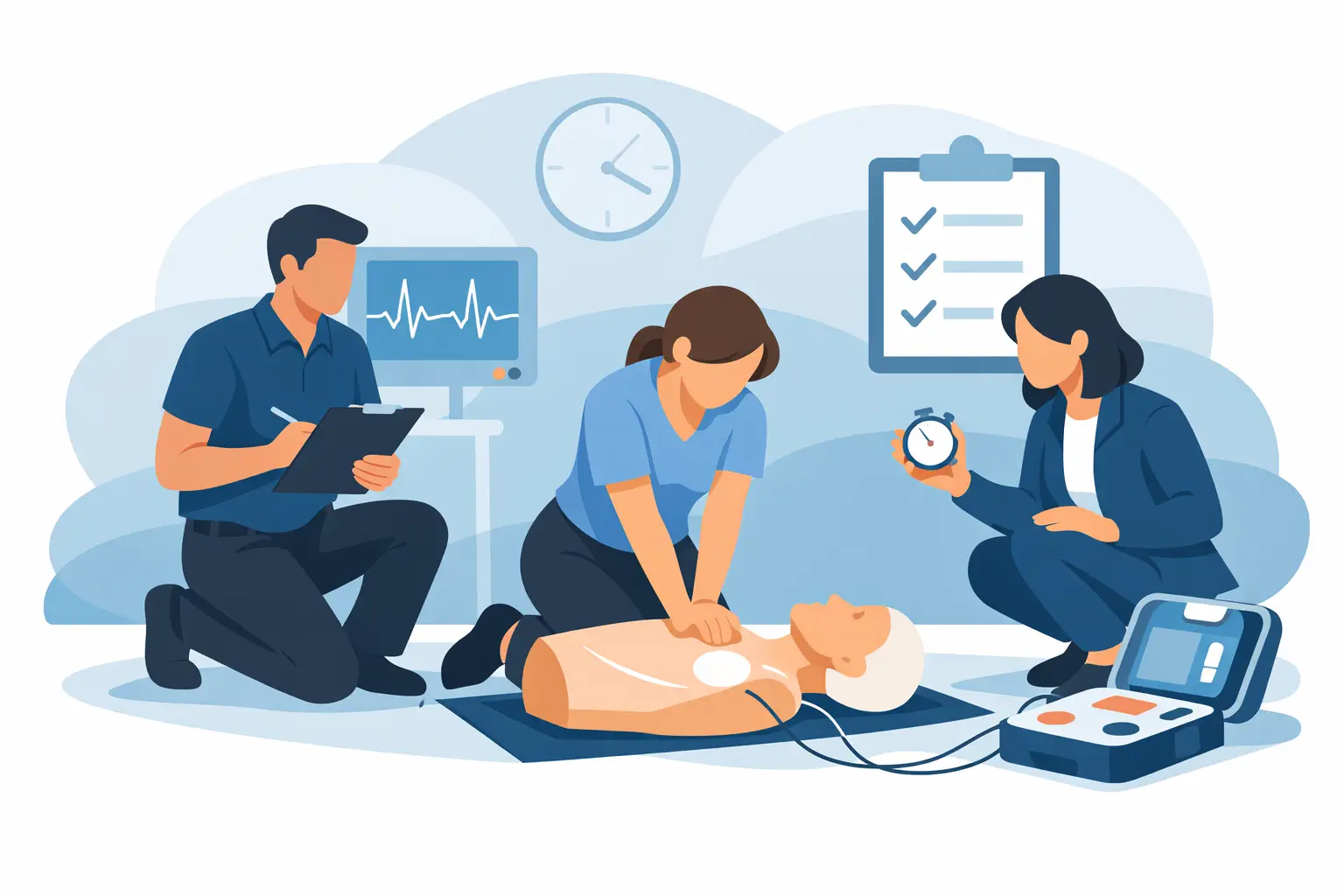
A CPR practical exam is not a written test where you repeat definitions from a manual. You are asked to respond to a realistic emergency scenario, demonstrate the correct sequence of care, and show that you can use CPR and an AED safely. If you are asking what happens in CPR practical exam sessions, expect hands-on assessment with a manikin, training AED, and direct observation from an instructor.
For most learners, the assessment is part of the in-person portion of a recognized first aid and CPR course. The goal is straightforward: confirm that you can apply the skills under pressure, not merely recognize the correct answer on a screen.
What Happens in a CPR Practical Exam?
The instructor will normally set up a scenario involving an unresponsive person. You may be told that the person has collapsed at work, in a public area, or at home. The scenario may begin with the manikin on the floor and no further instructions. That is intentional. You are expected to assess the scene and begin the emergency response process.
Your instructor watches both what you do and the order in which you do it. CPR is a sequence-based skill. Good chest compressions matter, but so do scene safety, calling for help, using available equipment, and continuing care until professional responders take over.
In a practical exam, the assessor may remain quiet while you work. They may also play the role of a bystander, answer questions as a dispatcher, or provide an AED when you request one. Follow the scenario as presented. If something is unclear, state what you would do in a real emergency and ask for the information or equipment you need.
The Skills You Will Usually Be Expected to Demonstrate
Course requirements can vary by certification level and training standard, but a CPR practical assessment commonly evaluates the following skills.
Scene safety and initial assessment
Before touching the person, check that the area is safe for you, the casualty, and bystanders. Look for hazards such as traffic, electrical risks, violence, fire, or unsafe surfaces. In a classroom setting, this may feel obvious, but saying and demonstrating the check shows that you understand rescuer safety.
Next, check responsiveness. Speak loudly, tap the person appropriately, and look for a response. If the person is unresponsive, call for help immediately. In a workplace context, this may mean directing a specific bystander to call 911 and return with an AED and first aid kit.
Being specific matters. Rather than saying, “Someone call 911,” point to a person and give a clear instruction: “You in the blue shirt, call 911 and bring the AED.” This reduces confusion and is a useful habit in real emergencies.
Breathing check and emergency activation
You will assess whether the person is breathing normally. Occasional gasps or irregular agonal breathing are not normal breathing and should be treated as a cardiac arrest concern. The assessment should be quick. Do not spend a long time trying to decide whether the person is breathing.
Once you determine that the person is unresponsive and not breathing normally, activate emergency medical services and begin CPR. Depending on the scenario, you may make the call yourself or instruct another person to call while you start care.
The examiner is looking for prompt action. A common mistake is spending too much time repeating checks instead of moving to compressions. In a real cardiac arrest, early CPR and early defibrillation are the priority.
High-quality chest compressions
Chest compressions are usually the central part of the practical exam. You will position your hands in the center of the chest, keep your arms straight, and use your body weight to compress the chest effectively. Adult CPR generally requires a rate of 100 to 120 compressions per minute and a depth of about 2 to 2.4 inches.
The instructor will watch for full chest recoil after each compression, minimal interruptions, correct hand placement, and a steady pace. The manikin may provide audible or visual feedback, but do not rely on it alone. Your body position and technique must still be correct.
Compression quality can decline quickly. If the scenario includes a second rescuer, you may be assessed on switching roles efficiently, ideally about every two minutes, without delaying compressions. Clear communication is part of the skill.
Rescue breaths, if included in your course
In many CPR courses, you will demonstrate a cycle of 30 compressions followed by two rescue breaths. You may use a face shield, pocket mask, or bag-valve mask depending on the course level and available equipment.
The instructor will check that you open the airway correctly, create a proper seal, and deliver breaths that make the chest rise. Blowing too forcefully or too quickly is not effective. Each breath should be controlled and just long enough to produce visible chest rise.
Some situations call for compression-only CPR if a rescuer is unable or unwilling to give breaths. However, if your practical assessment requires full CPR, do not skip the ventilation component unless the instructor’s scenario directs you to do so.
AED use
AED use is a core practical skill in many workplace CPR certifications. You will be expected to turn the unit on, expose and dry the chest if necessary, apply pads in the correct locations, and follow the device prompts.
The most critical safety point is clearing the person during rhythm analysis and before a shock. State clearly that no one should touch the person, visually check the area, and then press the shock button only when directed by the training AED.
After the AED gives its instruction, resume CPR without unnecessary delay. The device does not replace CPR. It works alongside it. Examiners often pay close attention to how quickly you return to compressions after a shock or a “no shock advised” message.
You May Be Tested on More Than One Scenario
A CPR practical exam may include adult CPR, child CPR, infant CPR, choking response, or a two-rescuer scenario. The exact assessment depends on the course you are taking and the certification level required by your employer.
For child and infant skills, the main sequence remains similar, but the technique changes. Compression depth, hand or finger placement, and the approach to rescue breaths must be appropriate for the casualty’s age and size. Do not assume that passing adult CPR automatically covers every pediatric skill.
Intermediate first aid courses may also assess how CPR fits into a broader emergency response. You could be asked to manage a scene, use personal protective equipment, communicate with emergency services, or coordinate another responder while providing care.
How Instructors Decide Whether You Pass
A practical assessment is generally based on whether you complete critical steps safely and correctly. The instructor is not looking for a perfect performance with no hesitation. Most learners are nervous, especially when being watched. A brief pause to gather your thoughts is usually less serious than skipping an essential safety step or failing to begin CPR promptly.
Critical errors may include failing to call for emergency help, providing compressions in the wrong location, not clearing the casualty before AED analysis or shock delivery, or stopping CPR without a valid reason. If you make an error, continue the scenario. The instructor may correct you, ask you to repeat a section, or provide another opportunity to demonstrate the skill.
Recognized training should include active coaching. The practical exam is an assessment, but it is also the final chance to correct technique before certification is issued. In a blended course, the online modules prepare you for the knowledge portion, while the in-person session confirms that your physical skills meet the required standard.
How to Prepare Without Overthinking It
Review the course material before attending the hands-on session, especially the adult CPR sequence, AED safety commands, and choking procedures. Wear comfortable clothing because you will be kneeling, leaning over a manikin, and practicing repeated compressions.
During practice, ask the instructor to check your compression depth, pace, and hand placement. Those are easier to correct in class than during an assessment. If you need a moment to remember the next step, say what you are assessing and proceed methodically.
For Ontario workers who need a recognized workplace credential, select a course that clearly states its certification level, in-person practical requirements, and acceptance for the purpose you need. Canada First Aid’s blended Intermediate First Aid Level C with AED training combines online learning with supervised in-person skills practice, which gives learners time to prepare before the hands-on assessment.
The practical exam is not designed to catch you out. It is designed to verify that, when someone collapses and seconds matter, you can recognize the emergency, call for help, start effective CPR, and use an AED with confidence.