AED Certification Requirements Guide for Ontario
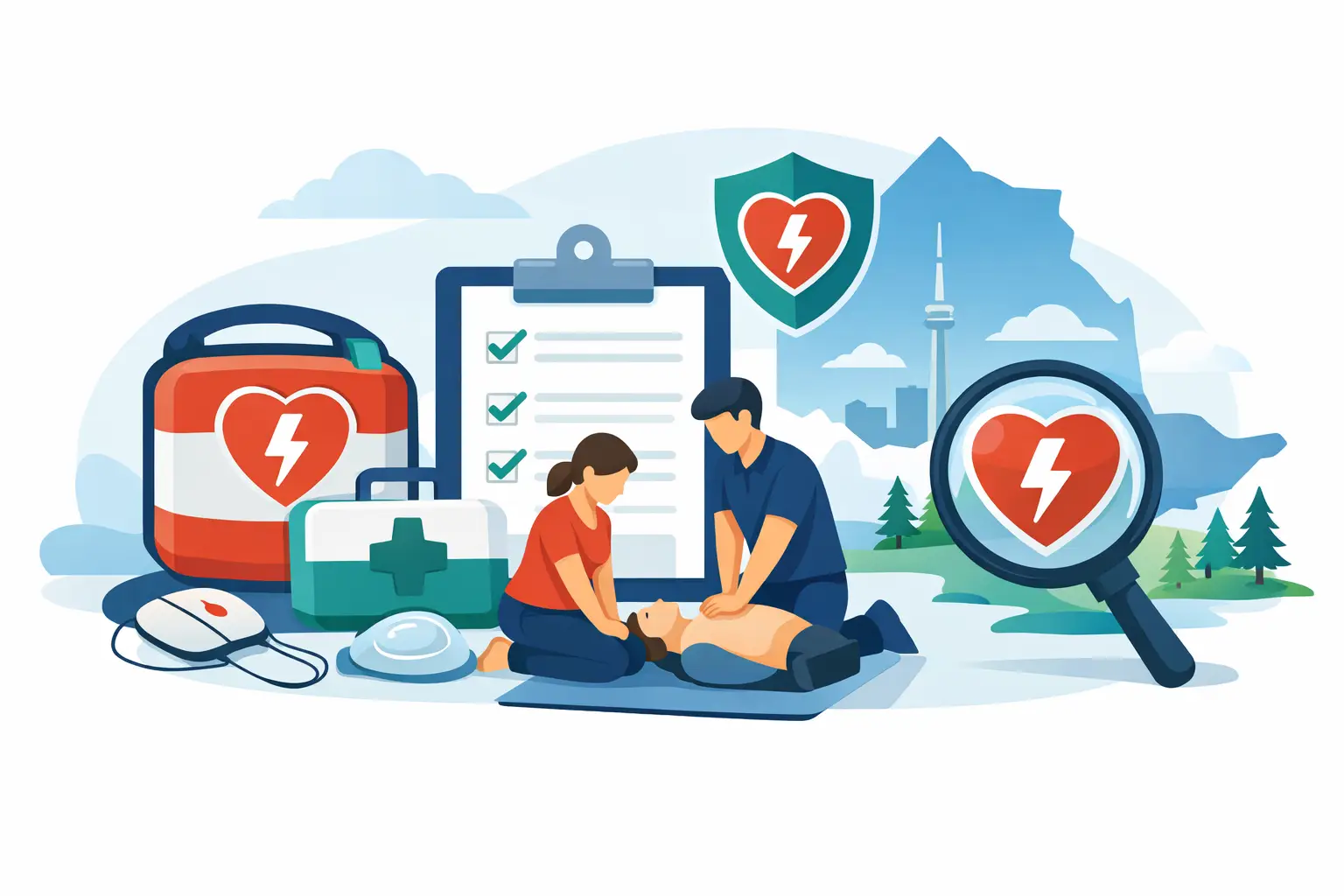
A job posting that asks for “AED certification” is usually asking for more than familiarity with the device. Employers typically need proof that you can assess an emergency, provide CPR, use an AED safely, and follow workplace response procedures. This AED certification requirements guide explains what to verify before enrolling, especially if you need recognized training for work in Ontario.
What AED Certification Usually Means
An automated external defibrillator, or AED, analyzes a person’s heart rhythm and can deliver a shock when appropriate. It is designed to guide a trained responder with clear voice and visual prompts. But using an AED is only one part of a cardiac emergency response.
For that reason, AED instruction is commonly included within a broader First Aid and CPR course rather than issued as a stand-alone workplace credential. A recognized certificate may be described as Emergency First Aid with CPR/AED, Standard or Intermediate First Aid with CPR/AED, or CPR Level C with AED. The right option depends on the job, the employer’s policy, and the workplace’s required level of first aid coverage.
Do not assume that a short AED awareness session meets an employer requirement. Awareness training may teach you where an AED is located and how it works, but it may not include hands-on CPR practice, formal assessment, or a recognized certificate.
AED Certification Requirements Guide: What Employers Look For
Before registering, start with the exact wording in your employment offer, job posting, union agreement, site contract, or workplace safety policy. “AED certification” can mean different things in different settings.
In most cases, an employer is checking four practical points:
- The course includes CPR and AED training, not AED awareness alone.
- The certificate comes from a recognized first aid training provider.
- The training level matches the duties and workplace requirement.
- The certificate is current on the date you begin work or report to a site.
Security personnel, supervisors, childcare staff, fitness workers, and employees assigned as workplace first aiders may need different course levels. A Level C CPR component is often requested when learners may need to respond to adults, children, and infants. Intermediate First Aid with CPR Level C and AED training is a common choice when an employer needs a more complete workplace credential.
For Ontario workplaces, recognition matters. If training is being used to meet workplace first aid obligations, confirm that the provider and course are accepted for WSIB purposes. A certificate that looks legitimate but does not meet the employer’s or workplace program’s standard can create a problem when you submit it.
Choose the Right Course Level Before You Pay
The least expensive course is not always the right course. If your employer requires Intermediate First Aid, an Emergency First Aid certificate will not be an equivalent replacement. Similarly, a CPR course without the required first aid component may not satisfy a designated first aider role.
Emergency First Aid with CPR/AED is generally suited to roles needing basic first aid and CPR skills. Intermediate First Aid with CPR Level C and AED certification provides a broader response scope and is often selected for workplace compliance, supervisory duties, security work, and positions where a more comprehensive credential is requested.
If the requirement is unclear, ask the employer a direct question before enrolling: “Do you require Emergency First Aid or Intermediate First Aid, and which CPR level must be included?” Also ask whether the certificate must be WSIB-recognized. That one conversation can prevent you from paying for a course twice.
A credible course description should state the certification name, included CPR level, AED component, delivery format, total instructional time, expiry period, and whether practical skills are assessed in person. If those details are vague, get clarification before registering.
Blended Learning Still Requires Hands-On Skills
Blended learning can be a practical option for adults balancing work, job searches, or shift schedules. It generally combines online theory with an in-person session where an instructor evaluates practical skills.
For example, Canada First Aid delivers Intermediate First Aid Level C with AED certification through eight hours of online coursework and eight hours of in-person instruction. The online portion allows learners to complete the knowledge component before class, while the in-person session focuses on the skills that cannot be properly evaluated from a screen.
Expect to practice chest compressions, rescue breathing where required by the course, AED pad placement, scene assessment, bleeding control, and emergency response procedures. You may also work through realistic scenarios and demonstrate that you can follow prompts, communicate with bystanders, and continue care until emergency services take over.
A fully online certificate may be suitable for general knowledge in some circumstances, but it is not automatically appropriate for formal workplace first aid requirements. When the certificate will be reviewed by an employer or used to fulfill a safety role, hands-on assessment is a significant part of its value.
What You Need to Complete the Course
Most adult learners do not need prior medical experience. You do need to attend the required sessions, complete the online coursework in a blended program, participate in practical exercises, and meet the course evaluation standard.
Wear comfortable clothing for the in-person class. CPR practice involves kneeling, bending, and working on the floor with training manikins. If you have a physical limitation, notify the provider before the course date. Training providers can explain what accommodations may be available and what physical performance requirements apply to certification.
Bring any information required for registration and make sure your name is entered correctly. Your certificate should match the name your employer uses in its records. After successful completion, save a digital copy of the certificate and keep the original documentation available if your supervisor, site manager, or client requests it.
Renewal Dates and Certificate Records
First aid and CPR/AED certificates are not permanent. In Ontario, workplace first aid certification commonly has a three-year validity period, but you should verify the expiry date printed on your certificate and your employer’s renewal policy. Some employers ask staff to renew early so there is no gap in site coverage.
Do not wait until the week your certificate expires. Course dates can fill, and a missed in-person session can delay your renewal. Set a calendar reminder several months before expiry, particularly if certification is a condition of employment.
Keep records organized. Your employer may need your certificate number, issue date, expiration date, training provider, and course level. If you work across multiple sites, carry a digital copy on your phone and store another copy where you can access it quickly. A supervisor should not have to chase employees for proof of current training after an incident or inspection.
AED Training Is Only Part of Workplace Readiness
A current certificate improves readiness, but it does not replace a workplace emergency plan. Employers should ensure trained staff know where first aid supplies and AEDs are located, how to call emergency services, who takes charge during an incident, and how to document what occurred afterward.
For employees, the practical standard is simpler: recognize an emergency, call for help, begin care within your training, use the AED as soon as it is available, and follow its prompts. Modern AEDs are designed to prevent a shock when it is not advised. Fast action, clear communication, and continued CPR can make a critical difference before paramedics arrive.
Choose a course that matches the credential your role requires, complete every required component, and keep the certificate current. That gives you more than a line on a resume. It gives your workplace a trained person who can act when the response cannot wait.