AED Certification: What Ontario Workers Need
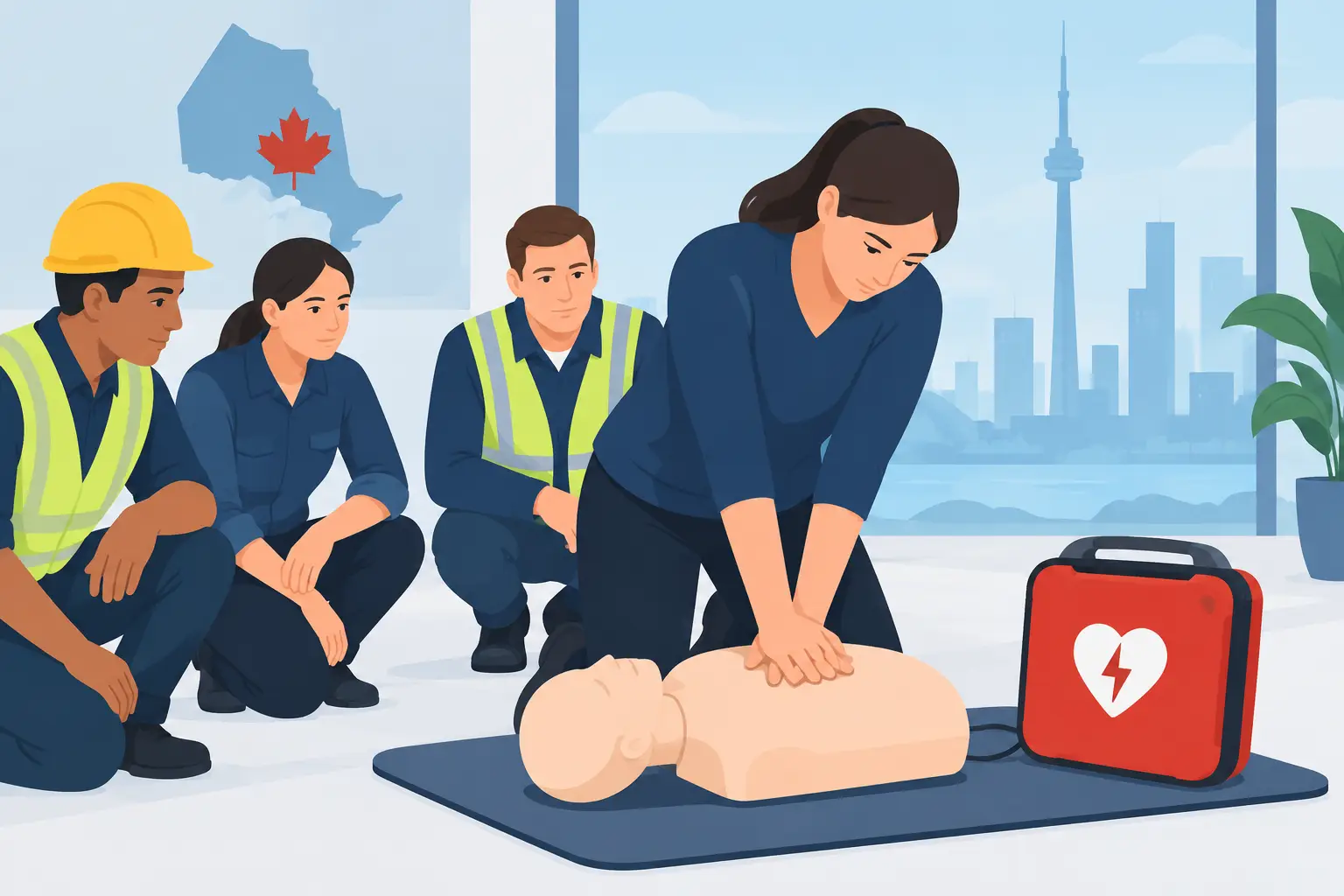
A cardiac emergency does not wait for a supervisor, a first aid room, or an ambulance to arrive. AED certification prepares a trained person to recognize a likely cardiac arrest, begin CPR, use an automated external defibrillator, and work effectively until emergency responders take over. For Ontario employees, job seekers, security personnel, and workplace supervisors, those are practical skills that can also satisfy an employer's training expectations.
An AED is designed to guide the user through the process, but that does not make training optional. A responder still needs to assess the scene, identify an unresponsive person who is not breathing normally, call 911, start high-quality CPR, apply the pads correctly, and follow the device without delaying care. A recognized first aid course gives people a structured way to practice those decisions before they face a real emergency.
What AED Certification Means
AED stands for automated external defibrillator. It is a portable device that analyzes the heart's rhythm and, when appropriate, advises or delivers a shock to help restore an effective rhythm. The AED provides voice and visual prompts, but it is only one part of an effective response. Early recognition, immediate CPR, fast access to an AED, and prompt emergency medical care all matter.
In most workplace training settings, AED instruction is included within a broader first aid and CPR certification rather than issued as a stand-alone credential. This matters when reviewing a job posting or an employer requirement. If an employer asks for CPR with AED training, confirm that the course certificate clearly includes both components and that the training meets the standard the employer accepts.
For many Ontario workplaces, Intermediate First Aid Level C with AED is the practical choice. It combines first aid assessment and treatment skills with adult, child, and infant CPR, AED use, and emergency response procedures. Level C refers to the CPR component covering all age groups. It is often appropriate for workers who may respond to coworkers, visitors, members of the public, or children.
Why Employers Ask for AED Certification
Employers do not ask for first aid credentials simply to fill a personnel file. They need designated responders who can act during a medical emergency while others call for help, retrieve equipment, direct emergency services, or manage the area. A current credential provides evidence that the employee completed a defined program and was evaluated on the required skills.
The exact requirement depends on the workplace, its hazards, its size, and the role. A security professional may need CPR and AED training because they are regularly first on scene in public-facing environments. A supervisor may need it because they are responsible for coordinating a workplace response. An employee may need the credential to qualify for a position, even when they are not formally designated as the primary first aid attendant.
Ontario workplaces must also consider applicable occupational health and safety obligations and Workplace Safety and Insurance Board expectations. Employers should verify which first aid level, certificate provider, renewal period, and number of trained workers apply to their operations. A course that is useful for personal preparedness may not be sufficient for a specific compliance requirement.
That distinction is worth making before registration. The lowest-cost or shortest course is not always the right course if an employer requires Intermediate First Aid Level C with AED. Confirm the course name in writing against the job requirement, particularly if the posting uses general terms such as “first aid certified” or “CPR required.”
What You Learn in an AED Course
Effective AED instruction is practical. Learners need more than an explanation of what a defibrillator does. They need to handle the equipment, place pads on a training manikin, clear the patient when directed, resume CPR without unnecessary pauses, and communicate with other responders.
A complete first aid and CPR course with AED training typically covers how to check scene safety and use personal protective equipment, how to recognize an unresponsive person and abnormal breathing, and how to activate 911 or the local emergency response plan. Participants practice chest compressions, rescue breaths when included in the course protocol, and AED operation for different age groups.
Training also addresses common situations that can affect AED use. For example, responders may need to dry a wet chest, remove medication patches where pads would be placed, or avoid placing pads directly over an implanted medical device. They learn to keep everyone clear while the AED analyzes the heart rhythm or delivers a shock. These details are manageable when practiced in class, but easy to miss under pressure without training.
First aid instruction adds another layer of readiness. Participants learn how to assess an emergency, manage severe bleeding, respond to choking, identify signs of stroke, and provide care for other urgent medical conditions until professional help arrives. The result is a credential that is more useful than AED operation alone.
The Role of Hands-On Practice
Online modules can efficiently cover theory, terminology, and response sequences. They cannot fully replace supervised practice. CPR depth and rate, correct hand placement, pad positioning, and team communication are physical skills. An instructor can identify errors immediately and require a learner to repeat a skill until it meets the course standard.
This is why blended learning can be a sensible format for busy adults. It separates the knowledge portion from the practical evaluation without removing the in-person component that gives the certificate credibility. Learners can complete foundational material online, then attend a focused session for scenarios, skill practice, and assessment.
A Practical Blended Path to Certification
Canada First Aid offers Intermediate First Aid Level C with AED certification through a blended format built for workplace and individual credential needs. The course includes eight hours of online coursework and eight hours of in-person instruction. This structure gives participants time to complete the academic component before attending a practical training session.
The in-person portion is where learners apply the material. Expect instructor-led demonstrations, CPR and AED practice, first aid scenarios, and assessment of required skills. Come prepared to participate. Comfortable clothing is usually the practical choice because CPR practice involves kneeling, bending, and working on the floor with training manikins.
Blended training is efficient, but it requires follow-through. Online coursework should be completed by the required deadline, and learners should arrive on time for the in-person session. Missing a practical assessment or leaving early can affect course completion. If you are registering for an employment deadline, leave enough time for both portions of the course and certificate processing.
How to Choose the Right AED Certification Course
Start with the requirement, not the course description. Ask your employer or prospective employer whether they require Emergency First Aid, Intermediate First Aid, CPR Level C, AED training, or a specific recognized provider. If you are responsible for workplace compliance, confirm the training level against your workplace's first aid assessment and current provincial requirements.
Then review the delivery format and time commitment. A blended course can reduce classroom time, but the online component is still real coursework. Make sure you can complete it without rushing. Also check the location of the in-person training, available dates, what identification or documentation is required, and whether the price includes certification materials.
Finally, confirm the certificate details. You should know the exact name of the credential, what CPR and AED components it includes, how long it is valid, and whether it is accepted for your intended purpose. Certification periods vary by program and organization, so do not assume an older certificate remains current simply because you have taken first aid before.
Keeping Your Skills Current
A certificate documents successful completion of a course, but skill retention depends on practice and refreshers. CPR quality can decline when people do not use the skills for a long time. AED procedures are straightforward, yet people may hesitate in an actual emergency if they have not reviewed the sequence since their course.
Workplaces can support trained staff by keeping AED locations clearly marked, maintaining the device according to the manufacturer's instructions, checking pad and battery expiry dates, and reviewing emergency response roles. Brief scenario discussions can also help employees understand who calls 911, who retrieves the AED, who meets paramedics, and who documents the incident.
For individuals, set a reminder well before your certificate expires. Renewing before an employer deadline avoids last-minute scheduling problems and keeps your qualifications ready when a job opportunity arises. More importantly, current training helps turn uncertainty into a clear response when someone suddenly collapses nearby.
The best time to decide how you would respond to a cardiac emergency is before one happens. Choose a recognized course that matches your workplace requirement, complete both the online and practical components, and keep your certification current.